When No One Else Would, He Did. Suveer Saigal, a student at The Shri Ram School, Moulsari, is rebuilding lives one woman at a time.
India's rehabilitation system has never answered one question well: what happens the morning after a woman walks out of prison?
She returns to a village where everyone knows where she has been. No income. No financial history. Often, no family is willing to stand beside her. The state that incarcerated her offers almost nothing on the other side. She is free, and entirely on her own.
Suveer found this unacceptable. Not in the way that prompts a social media post, but in a way that prompts a person to sit down and design something better.
What he designed is Project Navjeevan.
“Reintegration fails not because women lack the will to rebuild. It fails because no one constructs the conditions that make rebuilding possible. That is the gap Navjeevan exists to close.” — Suveer Saigal, Founder, Project Navjeevan
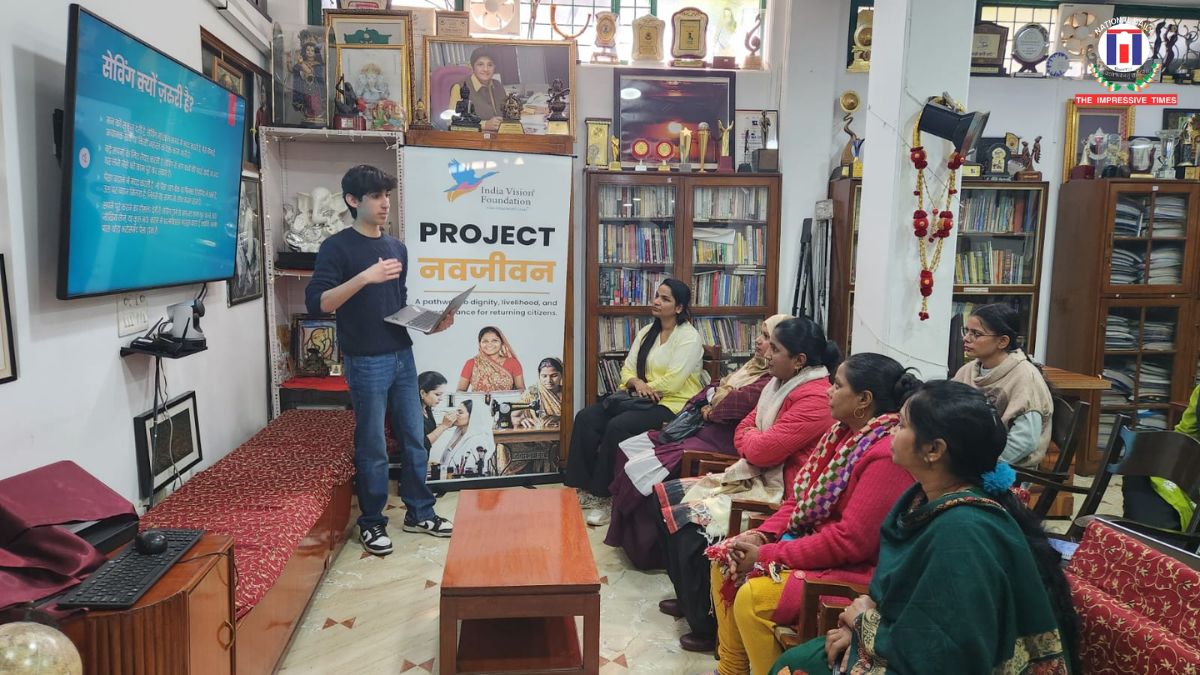
Developed through Neev Ventures, his youth-led social enterprise, and built in collaboration with India Vision Foundation, Navjeevan takes its name from the Hindi words for new and life. The name is deliberate. So is everything else about it.
Formerly incarcerated and undertrial rural women do not fail to reintegrate because they lack willingness. They fail because the system around them is not designed to receive them. Limited employment, no financial literacy infrastructure, fractured family ties, and the quiet, corrosive weight of stigma all converge the moment a woman comes home. Without intervention, what should be a transition becomes a trap.
Most people who recognise this problem write reports about it. Suveer built a programme.
Before a workshop, before a business plan, before a mentorship pairing, Navjeevan begins by understanding the individual. Her skills. Her family situation. Her economic baseline. Her social environment. The programme builds around her, not the other way around.
From that foundation, three structured stages follow. First, financial literacy: hands-on workshops giving women practical command over budgeting, savings, and income management. Second, enterprise creation: support in launching small, self-owned businesses, from food ventures to local services, with access to funding, materials, and branding guidance. Third, sustained mentorship to grow early ventures into stable, lasting livelihoods.
The changes Navjeevan produces are not dramatic. They accumulate slowly, then become irreversible. A woman who earns independently for the first time. Who walks back into her community without apology. Who begins, carefully, to trust that her future belongs to her.
Complementing this initiative is Suveer’s award winning documentary, “Rebuilding Freedom”, which captures the lived experiences of these women. Through storytelling, he brings visibility to narratives that are often ignored, creating not just awareness but empathy.
Over 21,500 women are currently lodged in Indian prisons. Post-release support for them is, by any honest measure, nearly nonexistent. Suveer’s ambition is proportionate to that gap, not because he believes one programme can reach every woman, but because he believes one programme, done rigorously, can prove the problem is solvable.
That is a particular kind of leadership. One that thinks past the immediate intervention toward the conditions that make change systemic. It is not a common instinct. It is rarer still in someone who has not yet sat his board exams.
Suveer Saigal is still in school. Project Navjeevan is already running. Somewhere in rural India, a woman who was told her story was over is learning it has only just begun, because a teenager decided that was not good enough.
















No Comments: