Defence Minister Rajnath Singh & Australian Defence Minister Richard Marles Strengthen India-Australia Strategic Partnership
India, Australia Strengthen Defence Partnership, Focus on Maritime Security and Advanced Technology Cooperation

 The Impressive Times
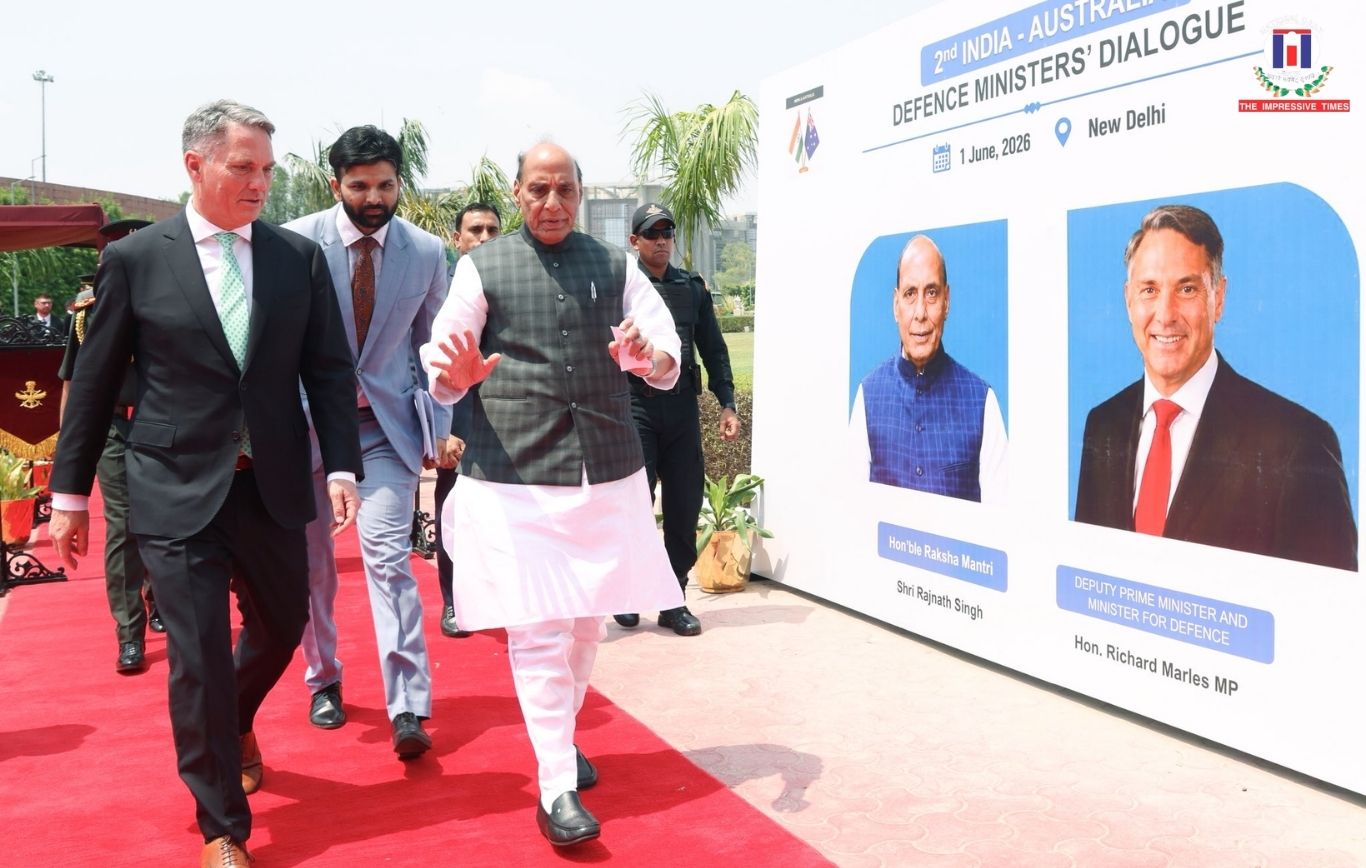
New Delhi, June 1: India and Australia have agreed to deepen their defence and strategic partnership, with a strong emphasis on maritime security, defence industry collaboration, and emerging technology research, during the second India-Australia Defence Ministers’ Dialogue held in New Delhi on Monday.
The high-level meeting was jointly chaired by Defence Minister Rajnath Singh and Australia’s Deputy Prime Minister and Defence Minister Richard Marles at the Manekshaw Centre. Both leaders reviewed the progress made in bilateral defence cooperation over the past year and outlined new areas for future collaboration.
The discussions focused on advancing the shared vision of both countries’ Prime Ministers to strengthen security cooperation, enhance collective capabilities, and contribute to stability across the Indo-Pacific region. The ministers also welcomed ongoing efforts to update and reinforce the bilateral framework governing defence and security relations.
Maritime security emerged as a key area of cooperation. India and Australia agreed to accelerate work on a Joint Maritime Security Collaboration Roadmap while expanding activities related to maritime domain awareness. The two nations will also explore greater cooperation in undersea surveillance and encourage closer engagement between the Indian Coast Guard and Australia’s Maritime Border Command.
Reaffirming their commitment to a rules-based international order, both countries stressed the importance of freedom of navigation, overflight rights, and uninterrupted lawful trade across regional waters in accordance with international law and the United Nations Convention on the Law of the Sea (UNCLOS).
As co-chairs of the Indian Ocean Rim Association’s Working Group on Maritime Safety and Security, India and Australia will jointly conduct a Search and Rescue exercise and tabletop drill in Chennai later this month. The initiative is aimed at improving maritime safety and strengthening regional cooperation in the Indian Ocean.
To boost defence industrial ties, the two sides announced plans to begin work on a new Memorandum of Understanding covering the supply of defence equipment and services. Officials will also explore additional opportunities for industry collaboration through existing bilateral mechanisms focused on defence research and technology development.
The dialogue highlighted growing cooperation in defence science and innovation. Both nations expressed interest in pursuing joint research projects in advanced technology sectors, including sensor systems and other emerging capabilities. Australia also invited India to participate in its Defence Science, Technology and Research Summit scheduled for 2026.
Military-to-military engagement continues to expand, with both sides welcoming participation in major multinational exercises. India is expected to increase its involvement in Exercise Talisman Sabre 2027, while both countries will continue participating in each other’s naval and air force exercises to enhance operational coordination and interoperability.
The ministers also acknowledged the broadening scope of military cooperation into new operational areas, including amphibious warfare, littoral operations, submarine rescue, and multinational humanitarian missions. They agreed that regular exchanges between military headquarters and the launch of Joint Staff Talks later this year would further strengthen strategic coordination.
On professional military education, both countries are working towards placing an Indian instructor at the Australian Defence College during 2028-29, a move expected to enhance knowledge sharing and deepen institutional ties between the armed forces.
The meeting also underscored the growing strategic alignment among Quad partners—India, Australia, Japan, and the United States. Both ministers reiterated support for initiatives aimed at improving maritime surveillance and information sharing across the Indo-Pacific region.
India and Australia further agreed to enhance cooperation under the Quad’s Maritime Domain Awareness initiative and work toward developing a common operational picture for the Indo-Pacific. The effort will build upon existing information-sharing mechanisms and regional maritime monitoring frameworks.
The dialogue concluded with both countries reaffirming their commitment to a secure, stable, and prosperous Indo-Pacific, while pledging to continue expanding defence cooperation across strategic, operational, technological, and industrial domains.



































No Comments: