Haryana to Expand Tax Base Instead of Raising Tax Rates, Says CM Nayab Singh Saini
State Sets 2030 and 2047 Revenue Targets Without Increasing Tax Burden

 The Impressive Times
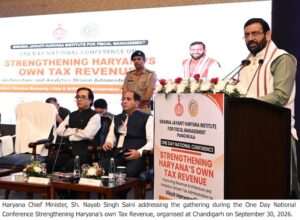
Chandigarh- Haryana Chief Minister Nayab Singh Saini on Wednesday said the state will strengthen its own revenue system by expanding the tax base, improving compliance, curbing revenue leakages and adopting modern technology, rather than increasing tax rates.
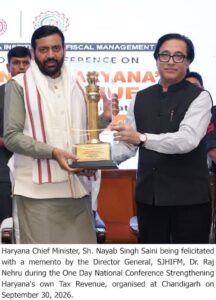
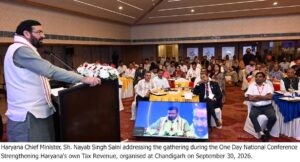
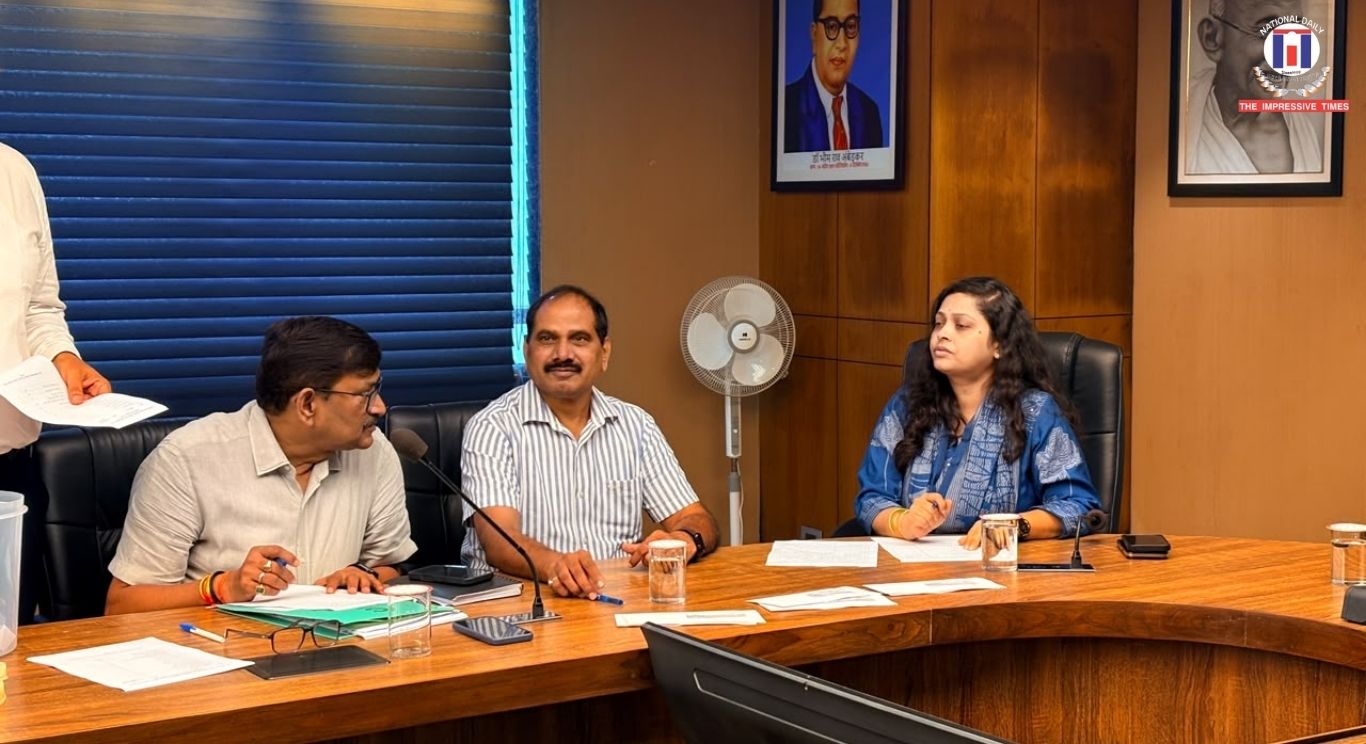
Saini made the remarks while inaugurating a national conference on analysing and strengthening Haryana’s Own Tax Revenue System for Viksit Haryana 2047, organised by the Swarna Jayanti Haryana Institute for Fiscal Management (SJHIFM).
The Chief Minister said the objective was to increase Haryana’s fiscal capacity without placing an additional burden on honest taxpayers. He stressed that a strong revenue system should ultimately translate into better roads, schools, hospitals and public services.
Saini said Haryana’s State Goods and Services Tax (SGST) collection increased 29% to ₹24,662 crore between April and August 2026, compared with ₹19,174 crore during the corresponding period last year.
The state also recorded a 21% rise in SGST collection in August 2026, against national growth of 13%, he said.
Haryana has less than 4% of the country’s total GST taxpayers but contributes around 7.7% of India’s total GST collection, highlighting the state’s strong economic activity and revenue potential.
The Chief Minister said Haryana’s own tax revenue currently remains below 7% of its Gross State Domestic Product (GSDP). The government has set a target of raising this share to 10% by 2030 and 15% by 2047.
He clarified that the targets would be achieved through greater efficiency and wider coverage of the existing tax system rather than higher tax rates.
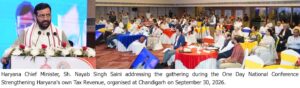
“The focus is on expanding the base, not increasing the rate; increasing compliance, not the burden,” Saini said.
Saini highlighted Haryana’s transition from an agriculture-based economy towards an industrial and services-driven economy.
He pointed to the expansion of Global Capability Centres, IT, artificial intelligence and advanced services in Gurugram, along with the India International Horticulture Market at Ganaur, automobile investments at IMT Kharkhoda and industrial and logistics projects in Rewari, Hisar and other parts of the state.
Traditional industrial clusters, including Panipat’s textile sector, Ambala’s scientific instruments industry, Hisar’s steel industry, Yamunanagar’s plywood sector and Rohtak’s nut-bolt and auto-component industry, were also identified as important contributors to Haryana’s economic strength.
Saini said the Haryana One-Time Settlement Scheme, 2026 has been extended until November 30 to help resolve old tax disputes and reduce litigation.
Around 1.15 lakh traders benefited from the 2025 scheme, he said.
The government is also implementing Paperless Registration 2.0 and the Auto Mutation System to make registration and mutation processes more transparent, digital and time-bound.
The Chief Minister said Haryana plans to make its future revenue administration increasingly data-driven.
Data from GST, registration, transport, electricity, urban development and other government systems can be integrated to build a comprehensive picture of economic activity, helping authorities identify potential revenue as well as gaps.
He said artificial intelligence, machine learning and advanced data analytics could be used to identify risks, prevent revenue leakages and improve tax compliance.
At the same time, technology should be used to improve services for honest taxpayers and not merely for monitoring, he added.
Chief Economic Adviser to the Government of India V. Anantha Nageswaran said Haryana has the economic dynamism, industrial base, entrepreneurial strength and governance capacity required to become a USD 1.5 trillion economy by 2047.
He highlighted Haryana’s role as one of India’s leading manufacturing centres and praised its efforts to simplify regulations and reduce the compliance burden.
Nageswaran also stressed the importance of trust-based and risk-based regulation, employment generation, income growth and consumption in strengthening the state’s tax revenues.
The conference brought together policymakers, tax administrators, economists, academicians and technical experts to discuss measures for strengthening Haryana’s revenue system and supporting the state’s long-term economic development.























No Comments: