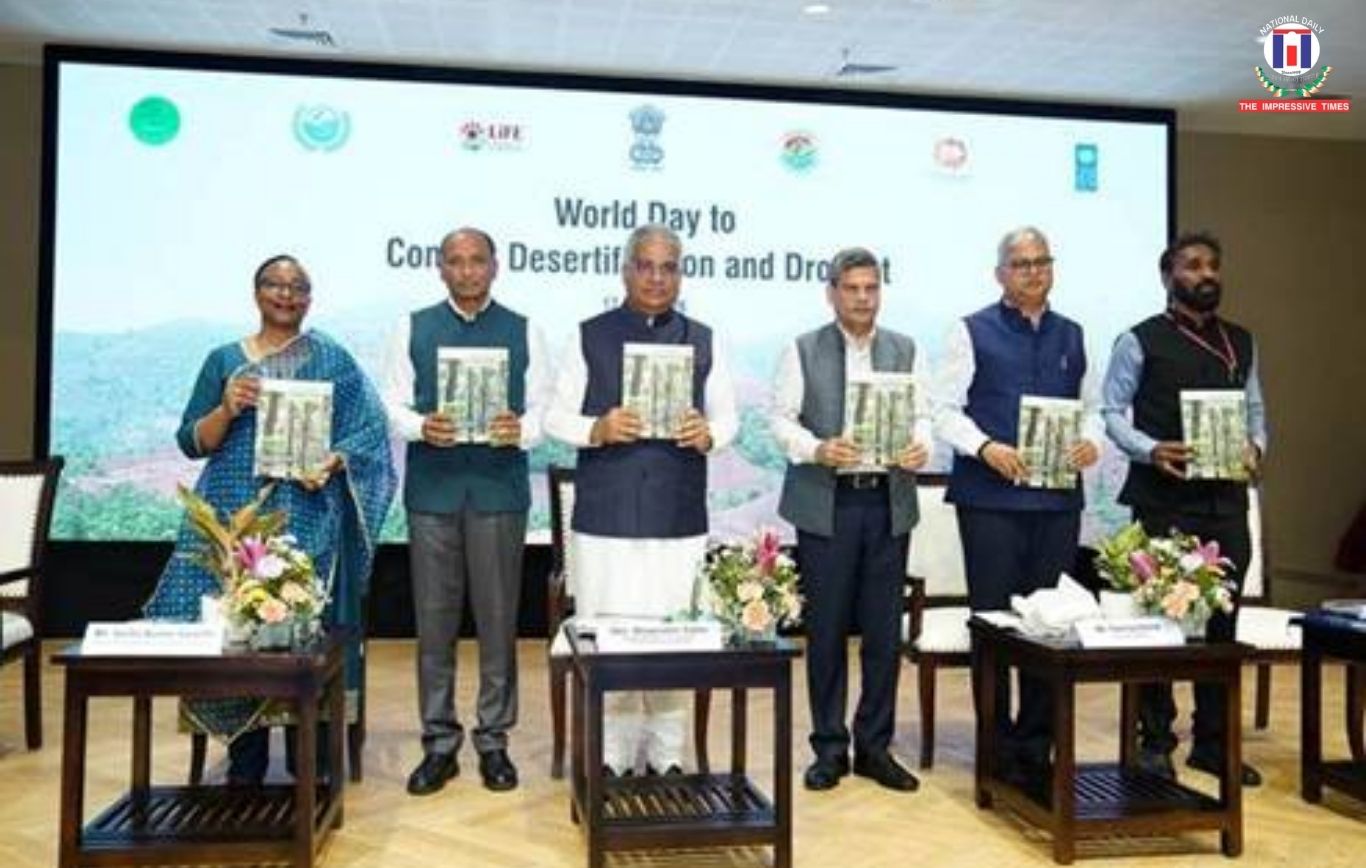
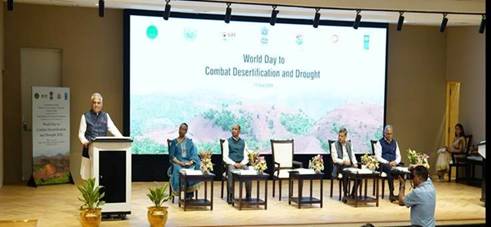
New Delhi, June 17, 2026: India has emerged as a significant global contributor in the fight against land degradation and desertification, with Union Minister for Environment, Forest and Climate Change Bhupender Yadav highlighting major achievements in large-scale land restoration efforts during an event marking the World Day to Combat Desertification and Drought in the national capital.
Addressing the commemorative programme held at Indira Paryavaran Bhawan, the Minister said India’s environmental strategy demonstrates how policy commitment, scientific innovation, and public participation can collectively drive meaningful ecological transformation. He reiterated that sustainable land management has become a central pillar of India’s development agenda under the broader vision of environmental resilience and climate action.
A key highlight of the address was India’s progress under the Bonn Challenge, a global initiative aimed at restoring degraded and deforested landscapes. The Minister informed that India has already brought 21.76 million hectares of land under restoration efforts against its ambitious target of 26 million hectares by 2030. He noted that the initiative, launched in 2011, seeks to restore 350 million hectares globally by 2030, and India remains one of the leading participating nations.
Yadav said the restoration drive has not only strengthened ecosystems but also generated approximately 1.22 billion person-days of employment, linking environmental recovery with rural livelihood generation on a large scale. He further emphasized that these efforts reflect the government’s long-term commitment under the leadership of Prime Minister Narendra Modi to restore ecological balance while ensuring inclusive development.
The Minister also highlighted significant progress under multiple national programmes. More than 27 million hectares have been treated under the Watershed Development Component of the Pradhan Mantri Krishi Sinchayee Yojana, while over 61.3 million geo-tagged natural resource management assets have been created to support scientific planning and monitoring. Under the Green India Mission, afforestation and greening activities have been undertaken across approximately 1.7 lakh hectares, while CAMPA-supported initiatives have contributed to afforestation over nearly 3.20 lakh hectares in the past five years.
Joint Forest Management, covering around 81.53 million hectares, continues to serve as one of the world’s largest community-based forest governance systems. In addition, agroforestry expansion over 1.21 lakh hectares and bamboo plantations across nearly 60,000 hectares outside forests have further strengthened India’s green cover and rural economy linkages.
A major success story shared during the event was the Aravalli Green Wall Initiative, which has surpassed its annual targets in the financial year 2025–26. The initiative is seen as a crucial landscape-level restoration programme aimed at combating desertification and improving ecological stability in the fragile Aravalli region.
The Minister also referred to the “Ek Ped Maa Ke Naam” campaign, under which more than 266 crore saplings have been planted across the country, marking one of the largest tree plantation drives globally. He underscored the role of digital platforms such as Bhuvan, VEDAS, and Yuktdhara in enabling science-based environmental planning and real-time monitoring of restoration activities.
Yadav further informed that under the MISHTI programme, a target has been set to restore 54,000 hectares of mangrove ecosystems by 2028, reinforcing India’s commitment to coastal resilience. Conservation efforts under the National Plan for Conservation of Aquatic Ecosystems are also being expanded, including the protection of Ramsar sites and wetlands of ecological importance.
He noted that India’s drylands, spanning around 228 million hectares, are vital for agriculture, livestock, and rural livelihoods, but face growing threats from land degradation. According to the India Desertification and Land Degradation Atlas, nearly 29.77 per cent of the country’s geographical area is currently affected by land degradation and desertification.
The Minister emphasized that India’s strategy moving forward will focus on landscape-level restoration, drought resilience, community participation, nature-based solutions, and innovative financing mechanisms. He said these efforts are not only restoring ecosystems but also strengthening livelihoods and ensuring long-term ecological security for future generations.
The event also witnessed the release of a special issue of Indian Forester and India’s second progress report on the Bonn Challenge (2011–2020), offering scientific insights and policy perspectives on sustainable land management and ecosystem restoration. Representatives from UNDP, government institutions, research bodies, and civil society participated in the discussions, underscoring the importance of collective global action.
Concluding the event, participants reaffirmed their commitment to accelerating restoration efforts and advancing India’s environmental goals in alignment with global sustainability frameworks.







































No Comments: