Xi Jinping Unveils Four-Point Plan During Meeting with Abu Dhabi Crown Prince
China Pushes Diplomatic Solution as US-Iran Tensions Escalate in West Asia

 The Impressive Times
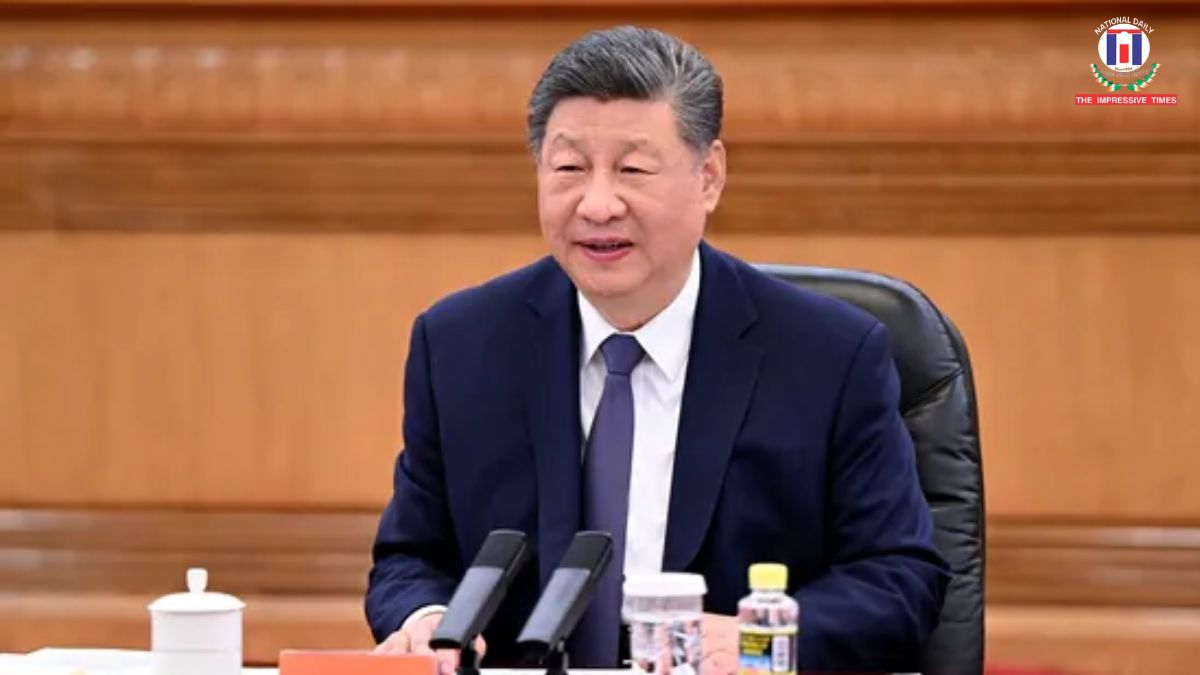
China’s President Xi Jinping has put forward a four-point proposal aimed at reducing tensions in the Middle East during a high-level meeting in Beijing with Khaled bin Mohamed bin Zayed Al Nahyan.
According to Chinese state media, the discussions focused on promoting stability in the region at a time when geopolitical strains are intensifying, particularly after recent diplomatic efforts between the United States and Iran failed to produce a ceasefire agreement.
During the talks, Xi outlined a framework built on four guiding principles: peaceful coexistence, respect for sovereignty, coordination between development and security, and protection of international law.
He stressed that global rules must be applied consistently, warning against selective adherence. Xi highlighted the importance of maintaining a fair international system and cautioned against a return to power-driven global order.
Tensions in the region have continued to rise following stalled negotiations between Washington and Tehran. The situation has been further complicated by Iran’s actions in the strategically vital Strait of Hormuz, where restrictions on certain vessels have disrupted maritime activity.
In response, the United States has increased military pressure, including moves targeting Iranian ports, escalating fears of a broader confrontation.
While Beijing has publicly maintained a neutral stance, its economic ties with Iran remain significant, particularly in the energy sector. Chinese firms have continued engagement with Tehran despite sanctions, underscoring the complexity of China’s position.
At the same time, China appears to be positioning itself as a diplomatic mediator, distinguishing its approach from that of Vladimir Putin, whose government has reportedly provided direct strategic support to Iran.
As instability persists, China’s latest initiative signals its intent to play a more visible role in shaping outcomes in the region, even as global powers remain deeply divided.
















![UEFA Champions League: 10-men United fall 2-0 to Atleti; Viking hold Bayern to 3-3 draw ANI | Updated: Oct 14, 2026 09:08 IST Madrid [Spain], October 14 (ANI): Manchester United’s 2026/27 season is turning out to be a disaster after the club showed promise following Michael Carrick taking the helm of the club in January, as it faced another loss on Tuesday (local time). In its first away fixture for this season’s UEFA Champions League at the Estadio Metropolitano stadium, the Red Devils were handed a 2-0 defeat by Atletico Madrid, causing the club more misery as it also struggles domestically. Pablo Barrios scored inside the opening minute for Atletico before substitute Ademola Lookman sealed the victory late in the second half. Barrios capitalised on an early lapse in Manchester United’s defence to put Atletico ahead within the first 60 seconds of the match. Despite the initial shock of conceding so early, United pushed for an equaliser, with Bryan Mbeumo leading the attack on most occasions without any significant result. The hosts controlled much of the first half with their high-intensity pressing and possession. Alejandro Grimaldo came close to extending the lead with a free kick that struck the woodwork. Manchester United looked to respond after the break but struggled to create any clear chances against Atletico’s defence. Bruno Fernandes came close to equalising in the 70th minute, rattling the crossbar with an effort from distance. ‹› United’s task became more difficult in the 74th minute when defender Leny Yoro received a red card over a reckless challenge on Jonathan David. Atletico made their numerical advantage count five minutes later. Lookman, who had come on as a substitute, reacted quickest after goalkeeper Senne Lammens parried Jonathan David’s initial shot and found the back of the net in the 79th minute to seal the victory. Both teams have now recorded one win and one defeat in the opening stages of the Champions League league phase. Elsewhere, Norwegian side Viking FK held Bayern Munich to a dramatic 3-3 draw in the league phase. Viking mounted a late comeback to earn a draw after Bayern had overturned a two-goal deficit. At the Viking Stadion in Stavanger, Norwegian side Viking FK held Bayern Munich to a 3-3 draw, scoring a dramatic late equaliser after the German side had overturned a two-goal deficit. Gianni Stensness gave Viking an early lead in the second minute with a header from a corner before Peter Christiansen doubled their advantage in the 38th minute. Bayern responded after the break, with Harry Kane scoring twice in the 54th and 60th minutes to level the score. Luis Diaz put the visitors ahead in the 71st minute. However, Bayern were reduced to 10 men three minutes later after Michael Olise received his second yellow card. Viking capitalised on the advantage as Herman Haugen scored in the 90th minute to secure a 3-3 draw. With one win and one draw, Bayern are placed fourth with four points, while Viking are 26th with a draw and a loss. (ANI)](https://impressivetimes.com/wp-content/uploads/2026/10/TIT-Website-Image-4-5.jpg)















No Comments: