New Delhi, October 14, 2026: Defence Minister Rajnath Singh on Wednesday called for an open, inclusive and peaceful Indo-Pacific region where all countries can make independent choices, safeguard their interests and pursue development without external pressure.
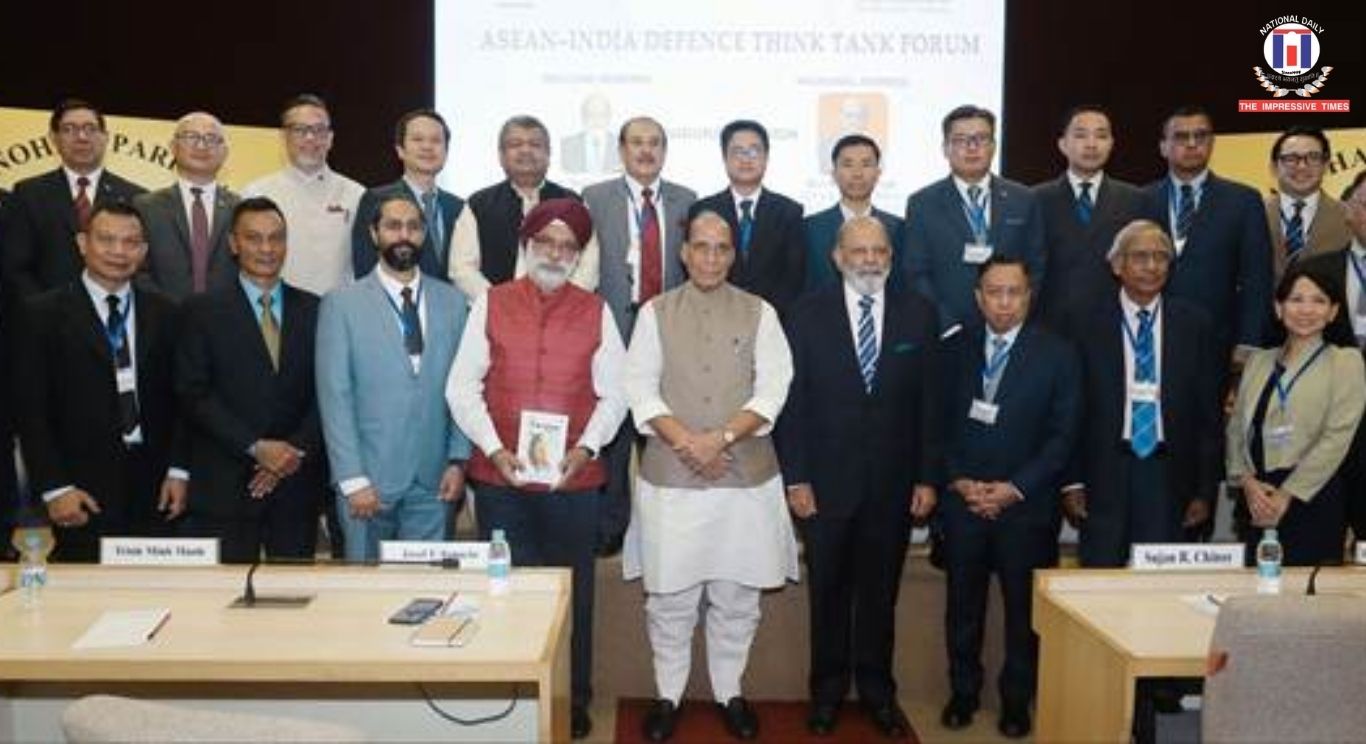
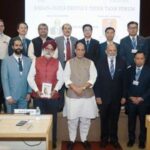
Addressing the first ASEAN–India Defence Think Tank Forum at the Manohar Parrikar Institute for Defence Studies and Analyses (MP-IDSA) in New Delhi, Singh emphasised the importance of building trust, respecting national sovereignty, following international law and maintaining open channels of dialogue to address emerging and traditional security challenges.
“India seeks an Indo-Pacific where all countries — large and small — make their own choices, protect their interests and pursue development in peace,” he said.
The two-day forum, being held on October 14 and 15, aims to strengthen strategic dialogue, promote joint research and identify practical opportunities for defence and security cooperation between India and the 11 ASEAN member states.
India and ASEAN Share Vision for Regional Stability
Singh said India and ASEAN share a common interest in peace, stability, prosperity and an open Indo-Pacific. He highlighted India’s Act East Policy, along with its SAGAR and MAHASAGAR visions, as key frameworks guiding engagement with the region.
He noted that increasing strategic competition and uncertainty at sea are creating new challenges for regional security. Other threats include terrorism, cybercrime, piracy, human trafficking, illegal fishing, climate-related disasters and disruptions to critical supply chains.
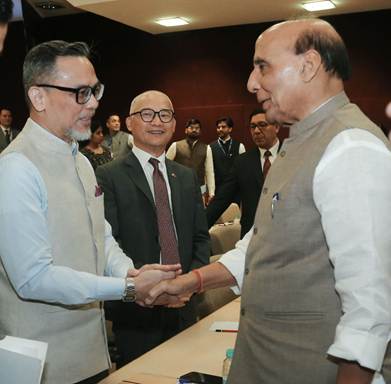
Emphasising the importance of peaceful engagement, Singh said differences should be addressed early before they escalate into disputes. He called for a regional order in which countries can cooperate without being compelled to choose sides.
He also underlined the historical connections between India and Southeast Asia, rooted in shared traditions, culture, trade and ideas, describing the Act East Policy as a long-term commitment to working with regional partners on an equal footing.
Maritime Cooperation a Key Priority
Highlighting the interconnected nature of the Indian Ocean and Southeast Asian waters, Singh said maritime security is a shared responsibility because these routes are vital for trade, energy supplies, people and essential goods.
He identified maritime domain awareness, interoperability among naval and coast guard forces, and underwater awareness as important areas for cooperation.
With 2026 designated as the ASEAN–India Year of Maritime Cooperation, Singh called for translating shared priorities into practical initiatives.
These include improving maritime information-sharing mechanisms, strengthening coordination among naval and coast guard forces, preparing joint responses to emergencies and combating piracy, trafficking and illegal fishing in accordance with international law.
Joint Defence Technology and Innovation
Singh highlighted the growing role of artificial intelligence, drones, cyber capabilities and space-based systems in modern defence. He noted that recent conflicts have demonstrated how relatively inexpensive unmanned systems can challenge costly military platforms, underlining the need for affordable, adaptable and effective solutions.
He called for greater collaboration among start-ups, universities, research institutions and smaller companies, citing India’s Innovations for Defence Excellence (iDEX) initiative and Technology Development Fund (TDF) as mechanisms supporting defence innovation.
The Minister proposed joint research projects, shared testing facilities, exchanges among young researchers and innovation challenges focused on clearly defined requirements, including counter-drone systems, cyber defence, maritime surveillance and disaster response.
He added that such cooperation must protect sensitive information, respect intellectual property rights and ensure the responsible sharing of technology.
India Offers Opportunities for Defence Industrial Partnerships
Singh said India was ready to explore defence industrial cooperation with ASEAN partners in areas such as patrol vessels, radars, air-defence systems, helicopters, drones and other technologies, based on individual countries’ needs and priorities.
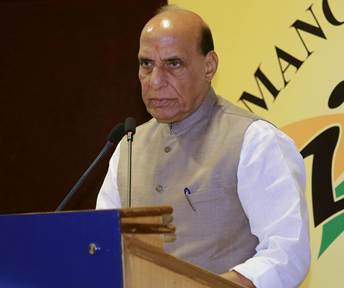
He clarified that the Aatmanirbhar Bharat initiative is aimed at strengthening domestic capabilities without isolating India from international partnerships.
“Self-reliance does not mean working in isolation; it can create opportunities for trusted partners to design, build, maintain and improve equipment together,” he said.
The Minister also emphasised co-development, co-production, maintenance, repair and overhaul (MRO), training and long-term technical support as important elements of sustainable defence partnerships.
According to Singh, such arrangements can strengthen local skills, support domestic industries and improve supply-chain reliability. He called for clear requirements, appropriate technology safeguards, fair sharing of responsibilities and benefits, and greater participation by local companies and skilled workers.
Disaster Response and Humanitarian Assistance
Singh called for making Humanitarian Assistance and Disaster Relief (HADR) a regular component of defence dialogue between India and ASEAN.
He highlighted the risks posed by cyclones, floods, rising sea levels and extreme weather, which can damage ports, disrupt trade and threaten lives and livelihoods.
He encouraged countries to share best practices, exchange experience and improve coordination before emergencies occur, enabling more effective regional responses to natural disasters.
Think Tanks Urged to Deliver Practical Outcomes
Emphasising the role of research institutions in policymaking, Singh called for the forum to produce actionable recommendations rather than limiting discussions to broad principles.
He outlined several proposed outcomes, including a joint India–ASEAN research agenda covering maritime security, cyber threats, emerging technologies, disaster response and defence industry cooperation.
Other proposals included fellowships and visiting programmes for researchers, joint publications, pilot projects on maritime disaster response and counter-drone solutions, and secure maritime information-sharing initiatives.
He also encouraged Track 1.5 and Track 2 dialogues, which bring together policymakers, practitioners, researchers and other experts, to sustain discussions between formal government meetings.
The Minister proposed preparing a concise set of recommendations, identifying institutions responsible for taking them forward and reviewing progress at a future meeting.
Forum Marks Milestone in ASEAN–India Defence Engagement
In his welcome address, MP-IDSA Director General Ambassador Sujan R. Chinoy described the forum as an important institutional milestone in the development of ASEAN–India defence engagement. He welcomed participants from India and all 11 ASEAN member states and expressed confidence that the initiative would strengthen dialogue between their strategic communities.
The forum follows an announcement by Singh at the second ASEAN–India Defence Ministers’ Informal Meeting in Kuala Lumpur on October 31, 2025, on the sidelines of the 12th ASEAN Defence Ministers’ Meeting-Plus.
Over two days, participants are scheduled to discuss regional geopolitics, strategic stability, maritime security, grey-zone challenges, defence technology, artificial intelligence, cybersecurity, space, unmanned systems and resilient supply chains.
The discussions are expected to identify practical avenues for deeper cooperation and contribute to a more structured, forward-looking defence and security partnership between India and ASEAN.














![UEFA Champions League: 10-men United fall 2-0 to Atleti; Viking hold Bayern to 3-3 draw ANI | Updated: Oct 14, 2026 09:08 IST Madrid [Spain], October 14 (ANI): Manchester United’s 2026/27 season is turning out to be a disaster after the club showed promise following Michael Carrick taking the helm of the club in January, as it faced another loss on Tuesday (local time). In its first away fixture for this season’s UEFA Champions League at the Estadio Metropolitano stadium, the Red Devils were handed a 2-0 defeat by Atletico Madrid, causing the club more misery as it also struggles domestically. Pablo Barrios scored inside the opening minute for Atletico before substitute Ademola Lookman sealed the victory late in the second half. Barrios capitalised on an early lapse in Manchester United’s defence to put Atletico ahead within the first 60 seconds of the match. Despite the initial shock of conceding so early, United pushed for an equaliser, with Bryan Mbeumo leading the attack on most occasions without any significant result. The hosts controlled much of the first half with their high-intensity pressing and possession. Alejandro Grimaldo came close to extending the lead with a free kick that struck the woodwork. Manchester United looked to respond after the break but struggled to create any clear chances against Atletico’s defence. Bruno Fernandes came close to equalising in the 70th minute, rattling the crossbar with an effort from distance. ‹› United’s task became more difficult in the 74th minute when defender Leny Yoro received a red card over a reckless challenge on Jonathan David. Atletico made their numerical advantage count five minutes later. Lookman, who had come on as a substitute, reacted quickest after goalkeeper Senne Lammens parried Jonathan David’s initial shot and found the back of the net in the 79th minute to seal the victory. Both teams have now recorded one win and one defeat in the opening stages of the Champions League league phase. Elsewhere, Norwegian side Viking FK held Bayern Munich to a dramatic 3-3 draw in the league phase. Viking mounted a late comeback to earn a draw after Bayern had overturned a two-goal deficit. At the Viking Stadion in Stavanger, Norwegian side Viking FK held Bayern Munich to a 3-3 draw, scoring a dramatic late equaliser after the German side had overturned a two-goal deficit. Gianni Stensness gave Viking an early lead in the second minute with a header from a corner before Peter Christiansen doubled their advantage in the 38th minute. Bayern responded after the break, with Harry Kane scoring twice in the 54th and 60th minutes to level the score. Luis Diaz put the visitors ahead in the 71st minute. However, Bayern were reduced to 10 men three minutes later after Michael Olise received his second yellow card. Viking capitalised on the advantage as Herman Haugen scored in the 90th minute to secure a 3-3 draw. With one win and one draw, Bayern are placed fourth with four points, while Viking are 26th with a draw and a loss. (ANI)](https://impressivetimes.com/wp-content/uploads/2026/10/TIT-Website-Image-4-5.jpg)








No Comments: