A Historic Step Towards a Stronger Supreme Court; Adv. Ujjwal Nikam Strongly Supports the Bill in Rajya Sabha
Ujjwal Nikam backs the Supreme Court Judges Amendment Bill, saying increasing judges from 34 to 38 will help reduce case pendency.

 The Impressive Times
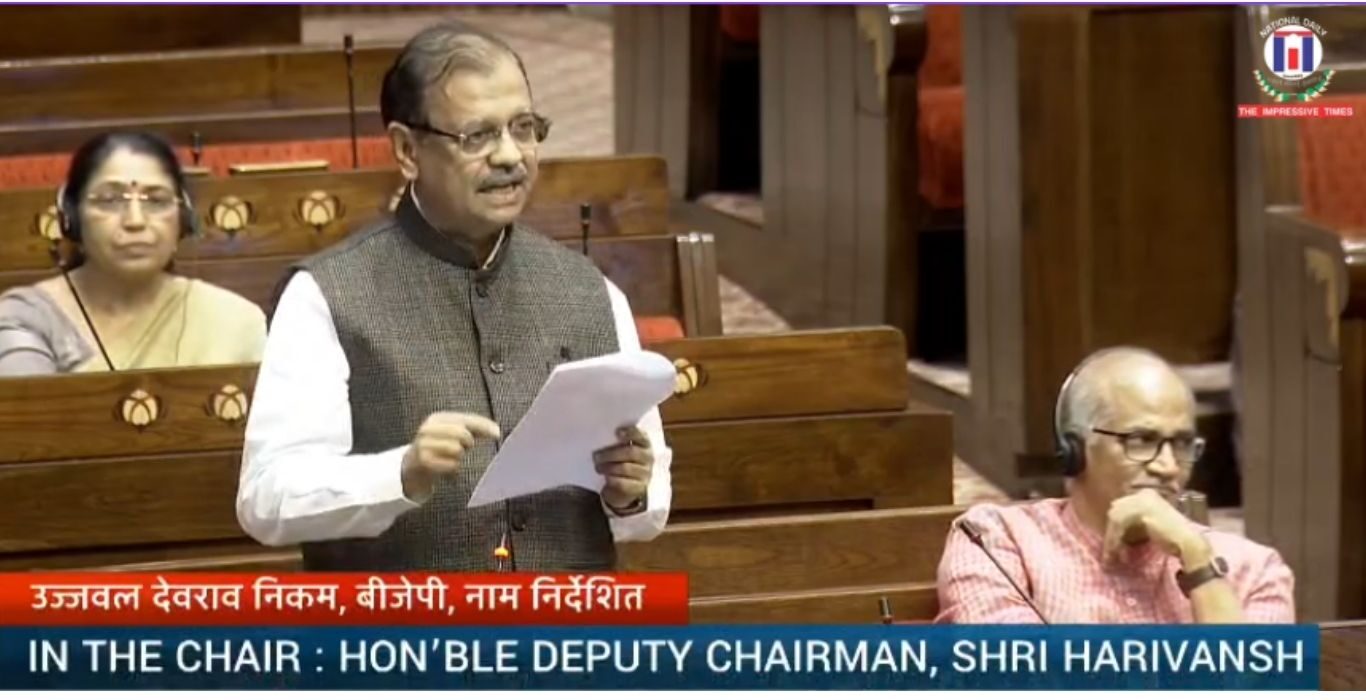
New Delhi: Speaking in the Rajya Sabha during the debate on the Supreme Court (Number of Judges) Amendment Bill, 2026, Maharashtra Member of Parliament and Senior Advocate Adv. Ujjwal Nikam extended his strong support to the Bill. He said that the decision to raise the number of judges in the Supreme Court from 34 to 38 is not a mere numerical increase, but a significant step towards making the delivery of justice faster, more effective and constitutionally stronger.
Twin benefits through Constitution Benches
Under Article 145 of the Constitution, every important question of constitutional interpretation must be heard by a Bench of at least five judges. When such Constitution Benches are constituted, several senior judges are occupied with them, which in turn affects the hearing of regular civil, criminal, bail and appeal matters. Increasing the number of judges will therefore serve a twin purpose, Nikam explained — on the one hand, constitutional questions will be heard more swiftly, and on the other, the pending civil, criminal, bail and appeal matters of ordinary citizens will be disposed of without delay.
A firm reply to the allegations on social representation
An allegation had been raised in the House that the Scheduled Castes and Scheduled Tribes do not receive adequate representation. Replying to it, Nikam pointed out that Bharat Ratna Dr. Babasaheb Ambedkar, who belonged to the Scheduled Castes, was independent India’s first Union Law Minister. The present Union Law Minister too belongs to the Scheduled Caste community, while Shri Kiren Rijiju, from the Scheduled Tribe community, has also successfully held the responsibility of Union Law Minister in this very Government.
Turning to representation within the judiciary itself, Nikam cited a further, telling example. Justice Bhushan Ramkrishna Gavai — a son of Maharashtra, a resident of Amravati, who practised for long years before the Nagpur Bench and belongs to the Scheduled Caste community — recently became the 52nd Chief Justice of India. Earlier, Justice K.G. Balakrishnan had served as the country’s first Dalit Chief Justice. The allegation that the Scheduled Castes and Scheduled Tribes have received no representation at the highest level of the judiciary is therefore contrary to facts, he asserted.
The gravity of pending cases
At present, more than 92,000 cases are pending before the Supreme Court. In the past year alone, over 75,000 fresh cases were filed, while about 65,000 cases were disposed of. Since the number of cases being filed exceeds the number being decided, strengthening the capacity of the Court is the need of the hour, Nikam said.
A call for a Judicial Accountability Bill
To make the judiciary more accountable, transparent and focused, Nikam made a fervent appeal to the Law Minister that the Central Government should consider a Judicial Accountability Bill. Such a legislation is the need of the hour and would make the judiciary more streamlined and answerable, he expressed. At the same time, he reiterated that the Government never interferes in the appointment of judges.
Concluding his remarks, Nikam said: “Justice delayed is justice denied. The court is the last refuge of the common citizen. Even when every other door closes, the door of justice must remain open — and it must open in time. This is the true spirit of our Constitution, and this Bill, which strengthens the capacity of the Supreme Court, is a significant step in that direction.”



































No Comments: