PM Modi Inaugurates SEMICON India 2026, Says India Emerging as Trusted Semiconductor Hub
M Modi inaugurates SEMICON India 2026, highlighting India’s semiconductor growth, $13.5-billion mission and global investment opportunities.

 The Impressive Times
New Delhi: Prime Minister Narendra Modi on September 17 inaugurated the fifth edition of SEMICON India 2026 in New Delhi, highlighting India’s rapidly expanding semiconductor ecosystem and its growing potential as a preferred destination for global chip manufacturing and technology investment.
Addressing industry leaders, researchers and international participants, Modi said India’s economic growth and rising global confidence in the country were creating new opportunities for innovation, investment and industrial expansion.
Drawing a connection between SEMICON India and Vishwakarma Diwas, the Prime Minister said the convergence reflected India’s traditional culture of creation and craftsmanship with 21st-century technology. He described this combination as an important source of inspiration for building a self-reliant and developed India.

The Prime Minister pointed to several recent developments as evidence of India’s economic momentum, including discussions on inclusive finance at the Global Fintech Fest, the operationalisation of a 3,000-km Dedicated Freight Corridor and 7.8 per cent quarterly GDP growth.
He also referred to a recent sovereign rating upgrade by a Japanese credit rating agency, saying the development reflected growing international confidence in the Indian economy.
Modi also cited the recently concluded BRICS Summit hosted by India, where the New Delhi Declaration was unanimously adopted, as another indication of India’s growing standing and global trust.
Recalling the evolution of SEMICON India since 2022, Modi said India’s semiconductor programme had progressed from policy discussions and project planning to pilot lines and commercial production.
He noted that chips manufactured in India have now started reaching customers in the country and abroad. Commercial production has also begun at two new plants in Mohali and Surat, marking a significant step in the development of the domestic semiconductor ecosystem.
The Prime Minister acknowledged the complexity of establishing a complete semiconductor ecosystem, which requires capabilities ranging from chip design and equipment manufacturing to testing and packaging. He credited industry partners for contributing to the rapid progress achieved by the sector.
Modi announced the $13.5-billion second phase of the Semiconductor Mission, along with regulatory reforms aimed at facilitating greater collaboration among international companies, startups and design firms.
He said the government was working to create conditions that would support the successful execution and expansion of semiconductor projects in India.
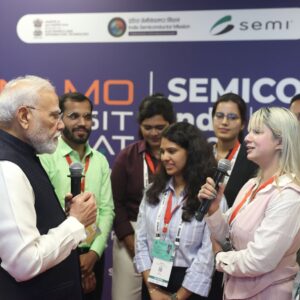

The Prime Minister also stressed the importance of developing a strong domestic supply chain. He called for greater focus on fabless semiconductor companies, intellectual property creation and silicon photonics, particularly to support infrastructure driven by artificial intelligence.
With 12 semiconductor projects already approved and demand continuing to grow, he urged companies involved in equipment, chemicals, gases and materials to make use of the emerging opportunities.
Highlighting India’s large pool of engineering talent, Modi said the country’s demographic advantage could become a major strength for the semiconductor industry.
The government is targeting the training of one lakh engineering students in chip designing, of whom 70,000 have already been trained, he said.
The Prime Minister also encouraged young researchers working in India as well as Indian researchers abroad to contribute to the development of advanced technologies in the country.
He called on industry leaders to increase investment in domestic research and development, saying stronger industry-academia engagement would benefit both companies and India’s young technical workforce.
Addressing the changing requirements of the semiconductor industry, Modi said the rapid growth of Artificial Intelligence was transforming the way chip performance was being evaluated.
He noted that the focus was increasingly moving beyond transistor size towards broader system-level considerations, including memory integration and heat management.
Against this backdrop, he said India was preparing to meet the changing requirements of global semiconductor manufacturing and positioning itself as a reliable manufacturing destination.
The Prime Minister also highlighted the growing energy requirements associated with AI data centres and semiconductor manufacturing facilities.
He pointed to India’s expansion of its power infrastructure, including solar capacity that has crossed 160 GW, the opening of the nuclear energy sector to private players and work towards small modular reactors.
According to Modi, reliable and adequate power supply would be a key strength for the semiconductor ecosystem as high-performance computing and advanced manufacturing continue to expand.
Concluding his address, Modi said India’s technological ambitions were closely linked with its democratic values and its long constitutional journey.
He said the emergence of a strong semiconductor industry in India, described as the “Mother of Democracy”, could strengthen global supply chains while creating new opportunities for investment, research, manufacturing and innovation.
The Prime Minister invited global industry stakeholders to participate in India’s semiconductor journey, saying the country’s aspirations and the opportunities being created were ready to welcome them.

































No Comments: