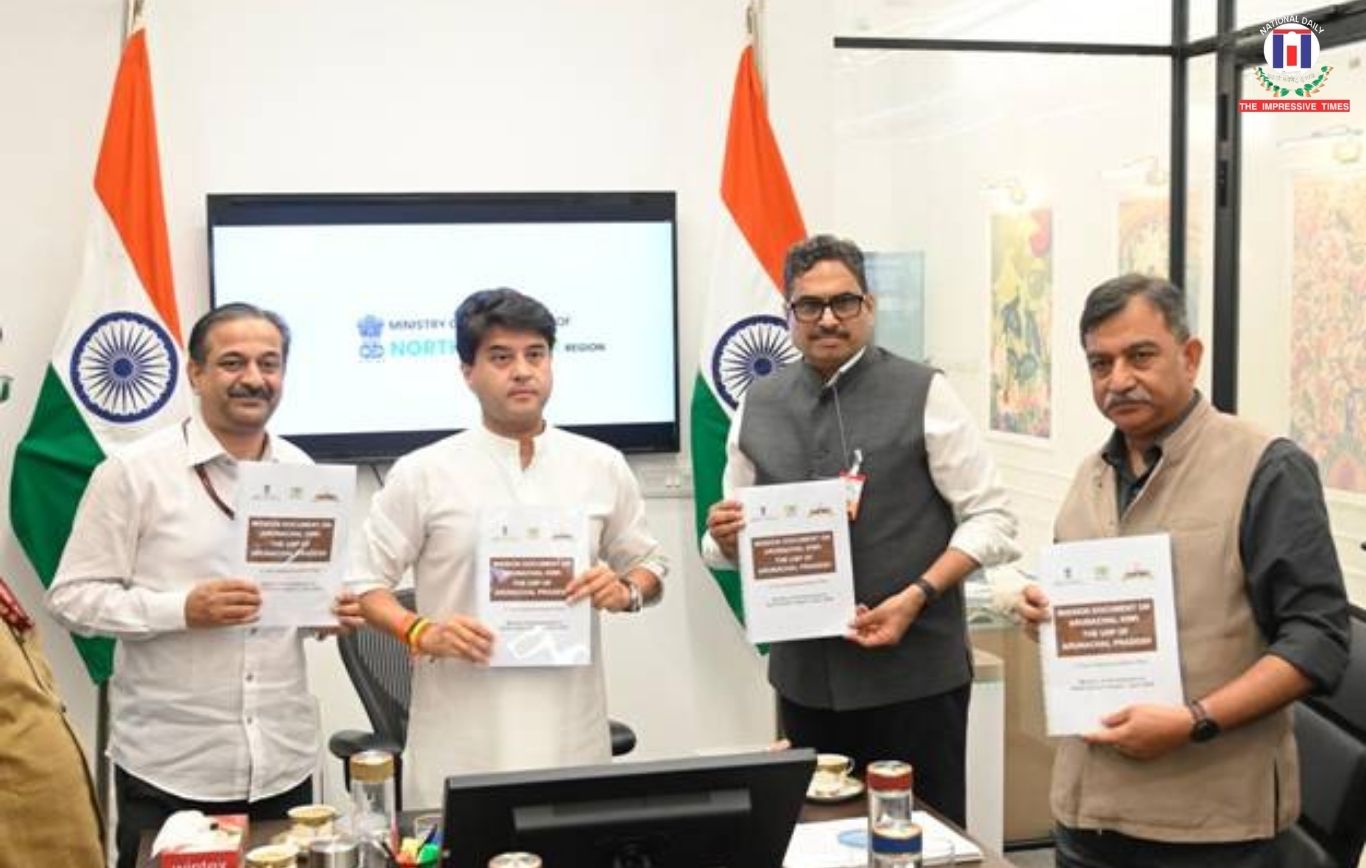
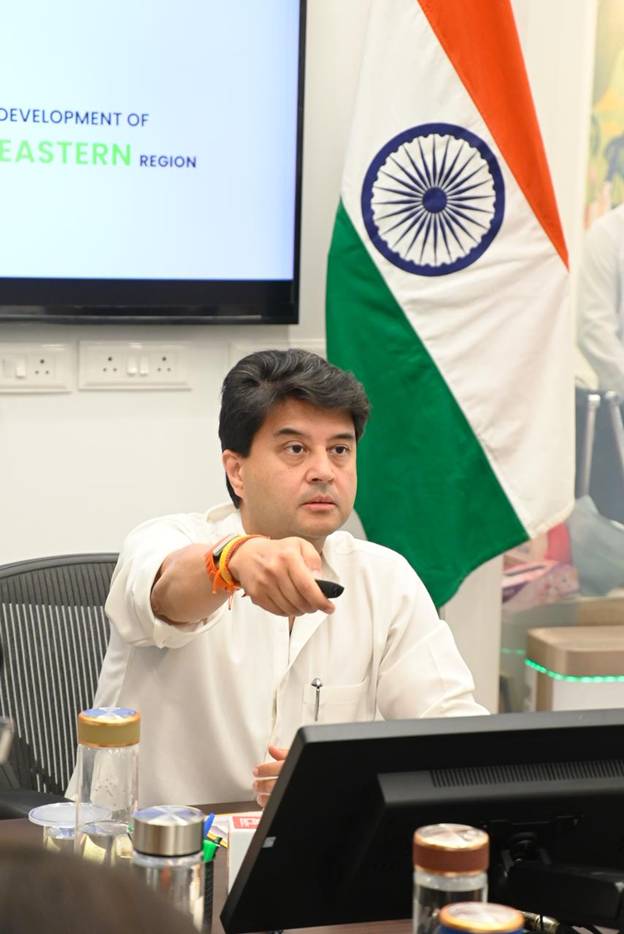
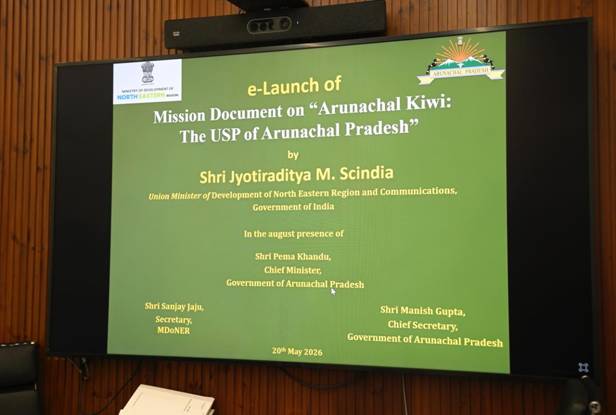
New Delhi, May 20, 2026: Union Minister for Development of North Eastern Region and Communications Jyotiraditya M. Scindia launched the Mission on “Arunachal Kiwi: The USP of Arunachal Pradesh,” a comprehensive cluster-based cultivation and value chain development programme aimed at transforming the state into a premium global hub for organic kiwi production.
The initiative, launched in the presence of Arunachal Pradesh Chief Minister Shri Pema Khandu and senior officials, has been designed with an outlay of approximately ₹167 crore under a convergence-led, whole-of-government approach. It integrates multiple central and state schemes along with institutional participation from organisations such as NABARD, ICAR-CITH, APEDA, NERAMAC and private sector stakeholders to strengthen the entire kiwi value chain.
The mission will be implemented through six integrated cluster-level post-harvest management hubs across key kiwi-growing regions, including Ziro Valley, Dirang, Kalaktang, Shi Yomi and Dibang Valley. The programme focuses on over 30 strategic interventions covering plantation development, post-harvest infrastructure, cold-chain logistics, branding, traceability systems and export facilitation.
A key objective of the mission is to address critical gaps in the existing value chain, particularly post-harvest losses, limited storage capacity, weak market linkages and distress sales caused by short shelf life. The initiative aims to significantly enhance price realisation for farmers while enabling Arunachal Pradesh’s kiwi produce to access premium domestic and international markets.
According to officials, Arunachal Pradesh currently contributes more than 50 percent of India’s kiwi production, with an annual output of over 7,050 metric tonnes. However, farmers often receive relatively low returns in comparison to international market prices. The new mission seeks to bridge this gap by strengthening Farmer Producer Organisations, reducing dependence on intermediaries and improving direct market access.
The programme is structured around four core pillars — convergence, value addition, branding and market integration. It also envisions creating a 2,000 metric tonne cold-chain capacity, expanding processing facilities, supporting agri-startups and ensuring traceable supply chains using modern digital technologies.
A major highlight of the mission is the development of the “Brand North East” identity, with Arunachal Organic Kiwi positioned as a premium export product. The initiative will leverage the state’s unique harvesting window between November and January, which aligns with the off-season in major global kiwi-producing countries, thereby creating export opportunities in South-East Asia, the Middle East and Europe.
The mission also includes plans to promote agri-tourism through orchard-based experiences, farm stays and farm-to-fork tourism circuits in regions such as Ziro Valley and Dirang, thereby integrating agriculture with rural tourism and local entrepreneurship.
Speaking at the launch, Scindia highlighted the importance of ensuring that farmers become active stakeholders across the entire agricultural value chain. He emphasised that the initiative reflects a collaborative model involving central ministries, state governments, research institutions and private players working together to build globally competitive agricultural ecosystems.
Chief Minister Pema Khandu described the mission as a transformative step for Arunachal Pradesh’s agricultural economy, noting that kiwi cultivation has already emerged as a sustainable alternative to traditional practices in high-altitude regions. He reaffirmed the state government’s commitment to aligning its own Arunachal Pradesh Kiwi Mission 2025–35 with the national initiative for time-bound implementation.
Senior officials noted that the mission will also focus on restoring organic certification systems, strengthening quality standards, and promoting export readiness through improved packaging, branding and certification mechanisms. The use of QR-enabled traceability systems is expected to ensure transparency from farm to market.
The initiative is expected to generate sustainable livelihoods, reduce post-harvest losses, improve farmer income levels significantly and encourage youth participation in agriculture-based enterprises. It also aims to reposition Arunachal Pradesh as a leading centre for organic horticulture in India.
With the launch of the Arunachal Kiwi Mission, the government has reinforced its broader vision of developing the North East as a hub of niche agricultural products, each state contributing a unique identity to the national and global marketplace.





























No Comments: