
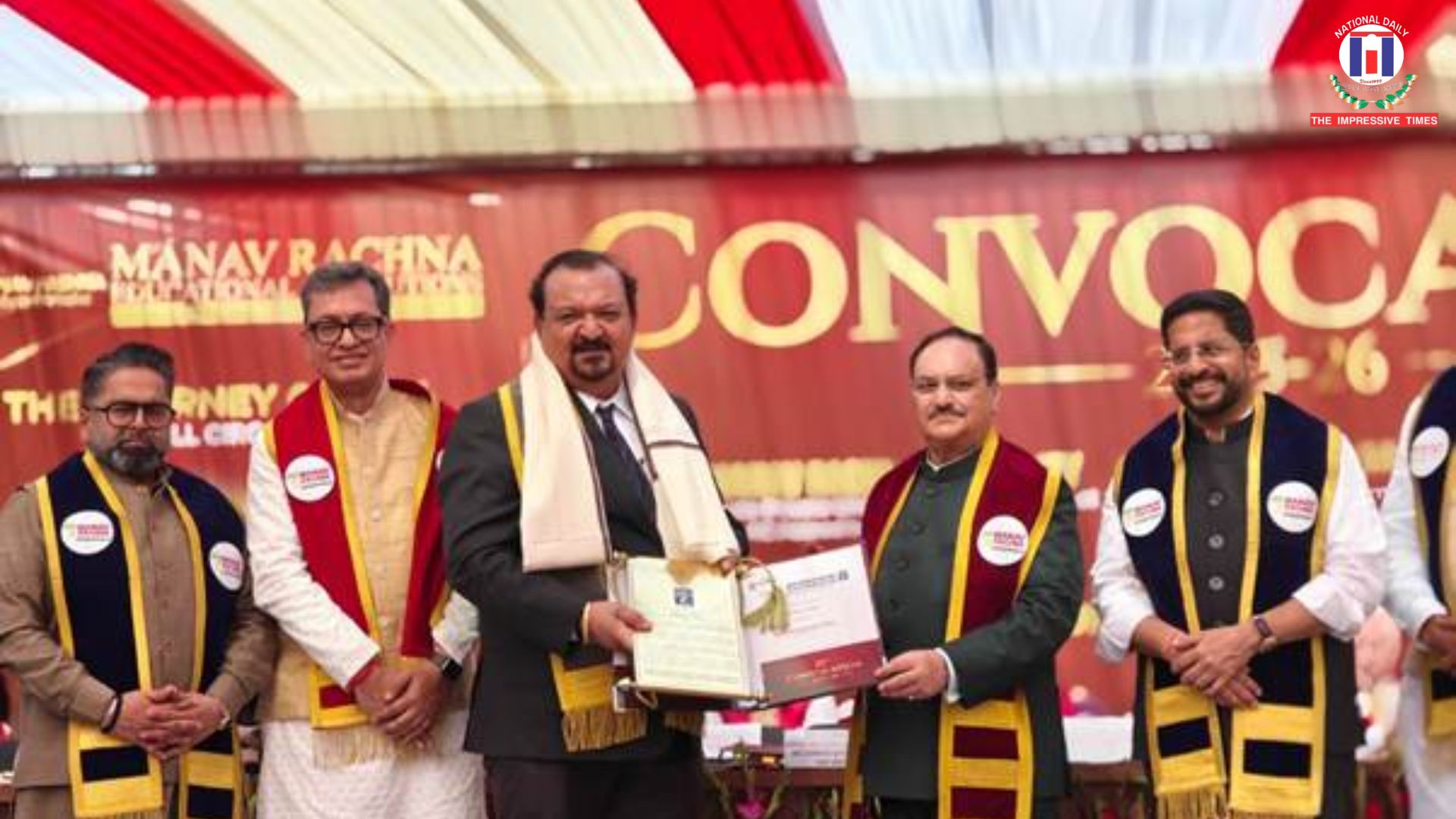

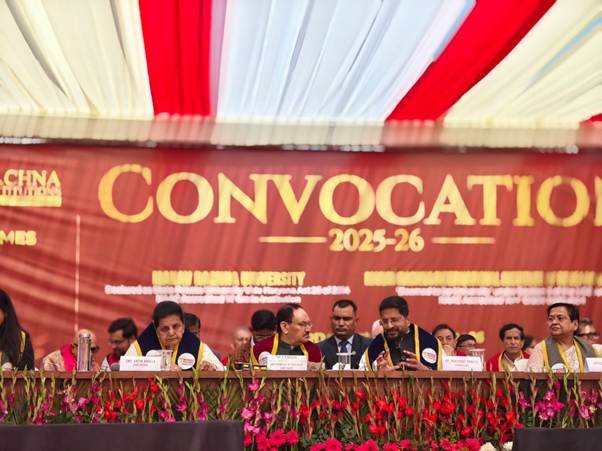
New Delhi : Union Minister for Health & Family Welfare and Chemicals & Fertilizers, Jagat Prakash Nadda, on Friday called upon young graduates to recognise their role as key stakeholders in India’s journey towards becoming a developed nation by 2047, as he addressed the Convocation Ceremony 2025–26 of Manav Rachna Educational Institutions (MREI).
Speaking before a large gathering of students, parents, faculty members and dignitaries, the Union Minister described the convocation as a defining moment that marks the transition from academic life to a phase of social and professional responsibility. He urged the graduating students to carry forward values of integrity, discipline and service, stressing that individual success must ultimately translate into collective national progress.
Nadda highlighted that the current generation of graduates is entering professional life during the second phase of Amrit Kaal, a period he described as one of unprecedented opportunity combined with heightened responsibility. He said the youth must contribute not only through professional excellence but also by addressing social challenges and strengthening public institutions.
Referring to India’s progress in the healthcare sector over the past decade, the Union Minister outlined major improvements achieved under the leadership of Prime Minister Narendra Modi. He noted the significant expansion of medical infrastructure, with the number of All India Institutes of Medical Sciences increasing from six to 23, strengthening access to quality healthcare across regions.
Citing key public health indicators, Nadda said institutional deliveries have seen a sharp rise, contributing to notable improvements in maternal and child health outcomes. He added that both the Maternal Mortality Ratio and Infant Mortality Rate have declined at a pace nearly three times faster than the global average, reflecting the impact of sustained policy interventions.
On communicable diseases, the Union Minister pointed out that India’s progress in tuberculosis control has received international recognition, with the World Health Organization acknowledging that the country’s decline rate is double the global average. He also noted that malaria-related deaths have been brought down to a fraction of previous levels, despite India being home to nearly one-sixth of the world’s population.
Nadda further emphasised the reduction in out-of-pocket healthcare expenses, attributing the decline to flagship initiatives such as Ayushman Bharat, the strengthening of Ayushman Arogya Mandirs, and nationwide screening programmes. These measures, he said, have helped make healthcare more affordable and accessible, particularly for vulnerable sections.
While highlighting achievements, the Union Minister also cautioned that India’s scale presents ongoing challenges. He urged graduates, especially those entering healthcare, education and public service, to maintain high standards of quality while catering to large populations. Acknowledging the role of families and educators, he credited parents, teachers and institutional leadership for nurturing the graduates’ academic and personal growth.
Concluding his address, Nadda reminded students that their achievements were made possible by society at large, and encouraged them to give back through service, innovation and ethical leadership.
Chancellor of Manav Rachna International Institute of Research and Studies and Manav Rachna University, Dr. Prashant Bhalla, also addressed the gathering, congratulating the graduating students and reaffirming the institution’s focus on innovation, industry engagement, global exposure and value-based education.
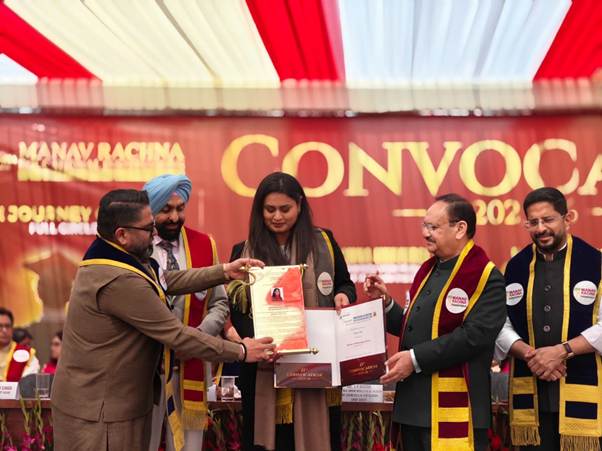
The ceremony also featured the conferment of honorary doctoral degrees on eminent personalities from diverse fields in recognition of their contributions to public life, healthcare, governance, sports and international relations.
A total of 2,150 students from engineering, management, law, education, sciences and healthcare streams were awarded degrees during the convocation. The graduating cohort included undergraduate, postgraduate and doctoral scholars, with meritorious students receiving medals and academic honours for outstanding performance.
The event was attended by senior officials, academicians, parents and students, marking a celebratory conclusion to an important academic milestone.

















No Comments: