ORV Sagar Manthan Launched in Kolkata, Set to Strengthen India’s Ocean Research Capabilities
ORV Sagar Manthan, India’s advanced ocean research vessel, was launched in Kolkata to strengthen indigenous deep-sea research and maritime capabilities

 The Impressive Times
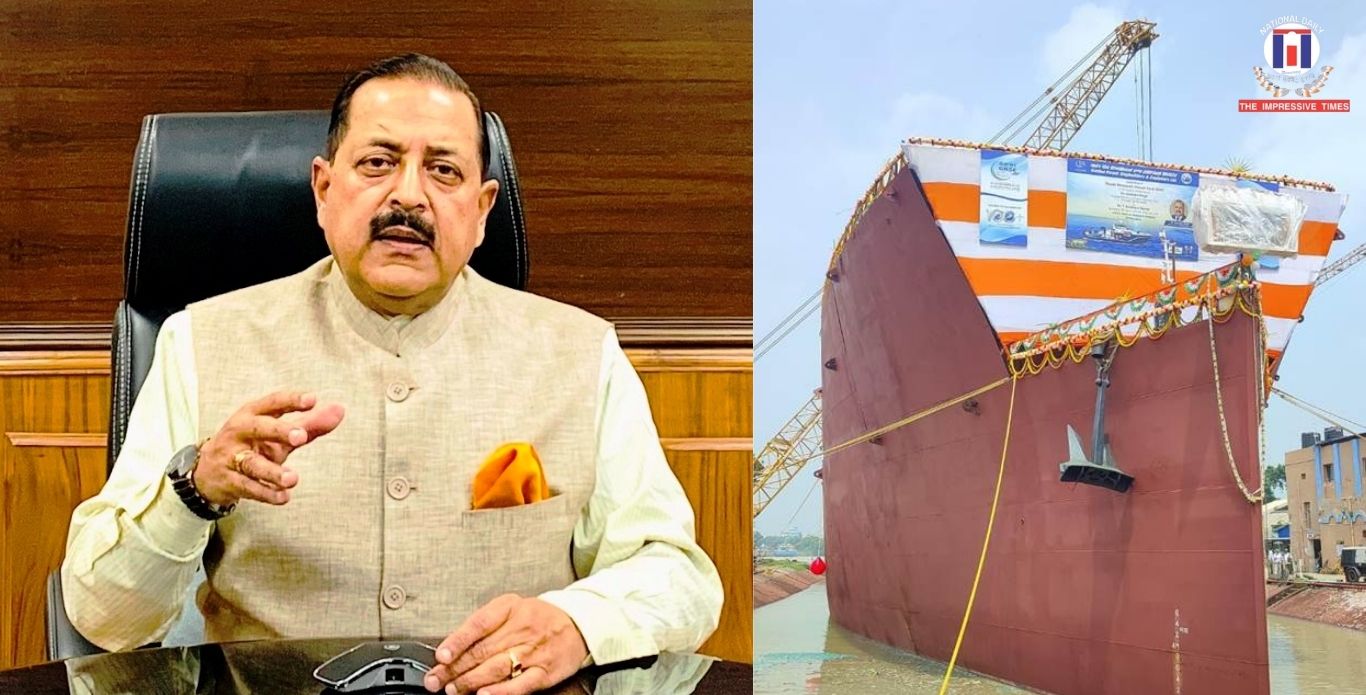
New Delhi- India has taken a major step towards strengthening its indigenous ocean research infrastructure with the launch of ORV Sagar Manthan, an advanced Ocean Research Vessel built in India for the National Centre for Polar and Ocean Research (NCPOR).
The vessel, identified as Yard 3041 during construction, was launched at Rishi Bankim Shipyard in Kolkata. It has been designed and constructed by Garden Reach Shipbuilders & Engineers Limited (GRSE) for the Ministry of Earth Sciences (MoES).
Union Earth Sciences Minister Dr. Jitendra Singh joined the launch virtually, while the vessel was formally named by his wife, Mrs Manju Singh, following the traditional naming ceremony.
Dr. Jitendra Singh described the launch as an important milestone for India’s scientific and maritime capabilities. He highlighted the importance of developing domestic expertise in oceanographic research, particularly as oceans play a critical role in understanding climate change, polar ice melt, environmental shifts and maritime developments.
According to the Ministry, the new vessel is expected to significantly enhance India’s ability to collect scientific data from the oceans and contribute to research linked to climate studies, disaster preparedness and maritime interests.
The minister also noted that ORV Sagar Manthan will eventually succeed the 43-year-old ORV Sagar Kanya, which was acquired from Germany in 1983.
ORV Sagar Manthan is being developed under Vertical-4 of the Deep Ocean Mission, which focuses on deep-ocean survey and exploration.
The project has an estimated cost of around ₹840 crore. Designed as a multidisciplinary, all-weather research platform, the vessel will be capable of operating in challenging environments, including the Southern Ocean.
It is expected to have a service life of approximately 30 years.
The vessel has been equipped with a range of specialised systems for deep-sea research and surveying.
Its capabilities include:
These systems will enable scientists to conduct detailed studies of the ocean floor, geological formations, water columns and atmospheric conditions.
The vessel will support research across multiple scientific disciplines. Among its planned activities are surveys of the mid-oceanic ridges in the Indian Ocean to study multi-metal hydrothermal sulphide mineralisation.
Researchers will also use the vessel to establish environmental baselines, carry out CTD profiling, collect water-column samples and obtain upper-air atmospheric observations.
These datasets are expected to support research into ocean processes, climate variability and India’s broader deep-ocean exploration efforts.
Earth Sciences Secretary Dr T. Srinivasa Kumar said the vessel represents a significant shift towards developing sophisticated research platforms within India instead of relying on overseas procurement.
He highlighted the vessel’s scientific capabilities, including underway swath multibeam surveys, geophysical profiling, atmospheric observations and water-column sampling.
The project also demonstrates the ability of Indian shipyards to undertake the construction of complex oceanographic platforms.
ORV Sagar Manthan has been constructed according to international regulatory requirements and carries dual-class certification from the Indian Register of Shipping (IRS) and the American Bureau of Shipping (ABS).
The vessel’s development reached several major milestones after the contract was signed in July 2024. First steel cutting took place on November 29, 2024, followed by keel laying on April 8, 2026.
The vessel has now entered the water and will undergo further construction and integration work.
Following the launch, work on the ship’s superstructure, system integration and sea trials will continue.
The vessel is scheduled to be delivered to NCPOR under the Ministry of Earth Sciences in 2028, after completing the required testing and commissioning procedures.
The ministry has also indicated plans to strengthen India’s oceanographic fleet further, including the proposed acquisition of additional research vessels and a dedicated Polar Research Vessel.




































No Comments: