Rural Jobs Framework Expands to 375 Works Under VB–G RAM G
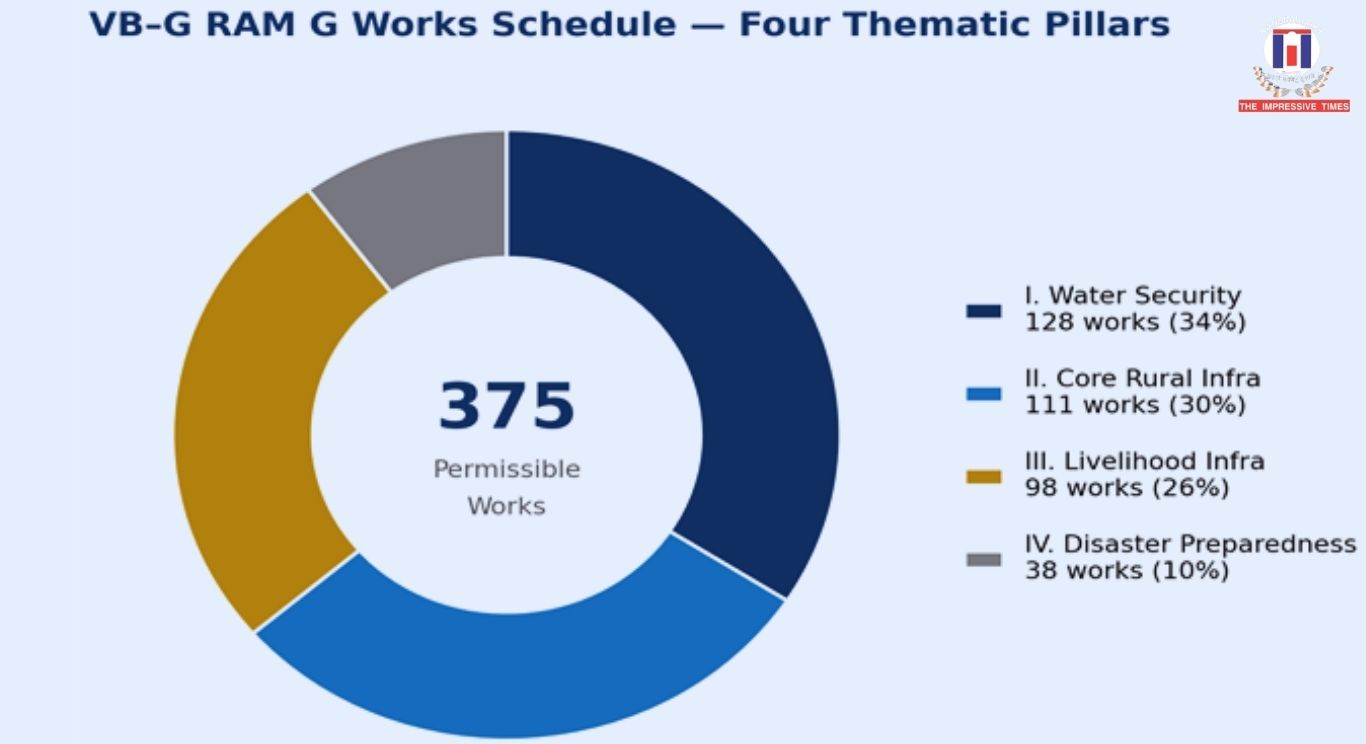
128 works under Water Security, 111 under Core Rural Infrastructure, 98 under Livelihood-related Infrastructure and 38 under Disaster Preparedness

 The Impressive Times
New Delhi- The Centre has expanded the scope of rural development works under the Viksit Bharat – Guarantee for Rozgar and Ajeevika Mission (Gramin) by notifying 375 permissible works, marking a 41 per cent increase over the 266 works covered under the earlier framework.
The Ministry of Rural Development said the new list is designed to link wage employment with long-term asset creation, rural livelihoods, water conservation and climate resilience. The works have been grouped into four broad areas — Water Security, Core Rural Infrastructure, Livelihood-related Infrastructure, and Extreme Weather and Disaster Preparedness.
The framework gives the largest share to Water Security with 128 works, covering measures such as check dams, recharge structures, rejuvenation of rivers and drains, reclamation of waterlogged land and renovation of field water-distribution systems. It also includes drip and sprinkler irrigation, rooftop rainwater harvesting, tankas, ice stupas and artificial glaciers.
Another 111 works have been included under Core Rural Infrastructure, covering facilities and services such as solar street lighting, waste recycling units, greywater treatment systems, rural libraries, health and veterinary centres, Common Service Centres, youth facilities and additional classrooms and laboratories. Repair and maintenance of Jal Jeevan Mission infrastructure has also been included.
The revised framework significantly increases the focus on livelihood-generating infrastructure, with 98 works covering agro-processing, grading and packaging, cold storage, dairy facilities, mushroom sheds, sericulture, polyhouses and aquaculture infrastructure.
The Ministry said livelihood-related works now account for 26 per cent of the total permissible works, compared with just 1.1 per cent under the previous framework. Infrastructure for Self-Help Groups, including worksheds, SHE Marts and federation buildings, along with training and skill-development centres, has also been included.
For the first time, the framework has a dedicated category for extreme weather events and disaster preparedness, comprising 38 works. These include flood shelters, retaining walls, embankment strengthening, flood protection measures, restoration of rural roads and community assets after disasters, and forest-fire management infrastructure.
The new list also places emphasis on farmers and vulnerable sections. 181 works have been identified under agriculture and allied activities, including 52 individual-beneficiary works linked to productive assets such as water, land, plantations and livestock.
Another 107 works have been tagged for Antyodaya and vulnerable households, including 68 individual-beneficiary works covering areas such as housing, sanitation, energy, irrigation and livestock shelters.
The framework includes 36 works focused on Nari Shakti and 36 on Yuva Shakti, with provisions for women’s collectives, Self-Help Groups, youth centres, skill development and enterprise-linked infrastructure.
The Ministry has also incorporated provisions for accessibility for persons with disabilities, renewable-energy infrastructure, emergency shelters in border areas and circular-economy initiatives such as waste-to-wealth recycling and greywater treatment.
All works will be identified through Viksit Gram Panchayat Plans based on local requirements and will require approval from the Gram Sabha. Their implementation will be digitally tracked through the Viksit Bharat National Rural Infrastructure Stack, which is also intended to support convergence among Central, state and local schemes and prevent duplication.
The expanded framework seeks to shift rural employment works towards the creation of durable assets while simultaneously addressing water security, livelihoods, infrastructure gaps and the growing risks posed by extreme weather events.






















No Comments: