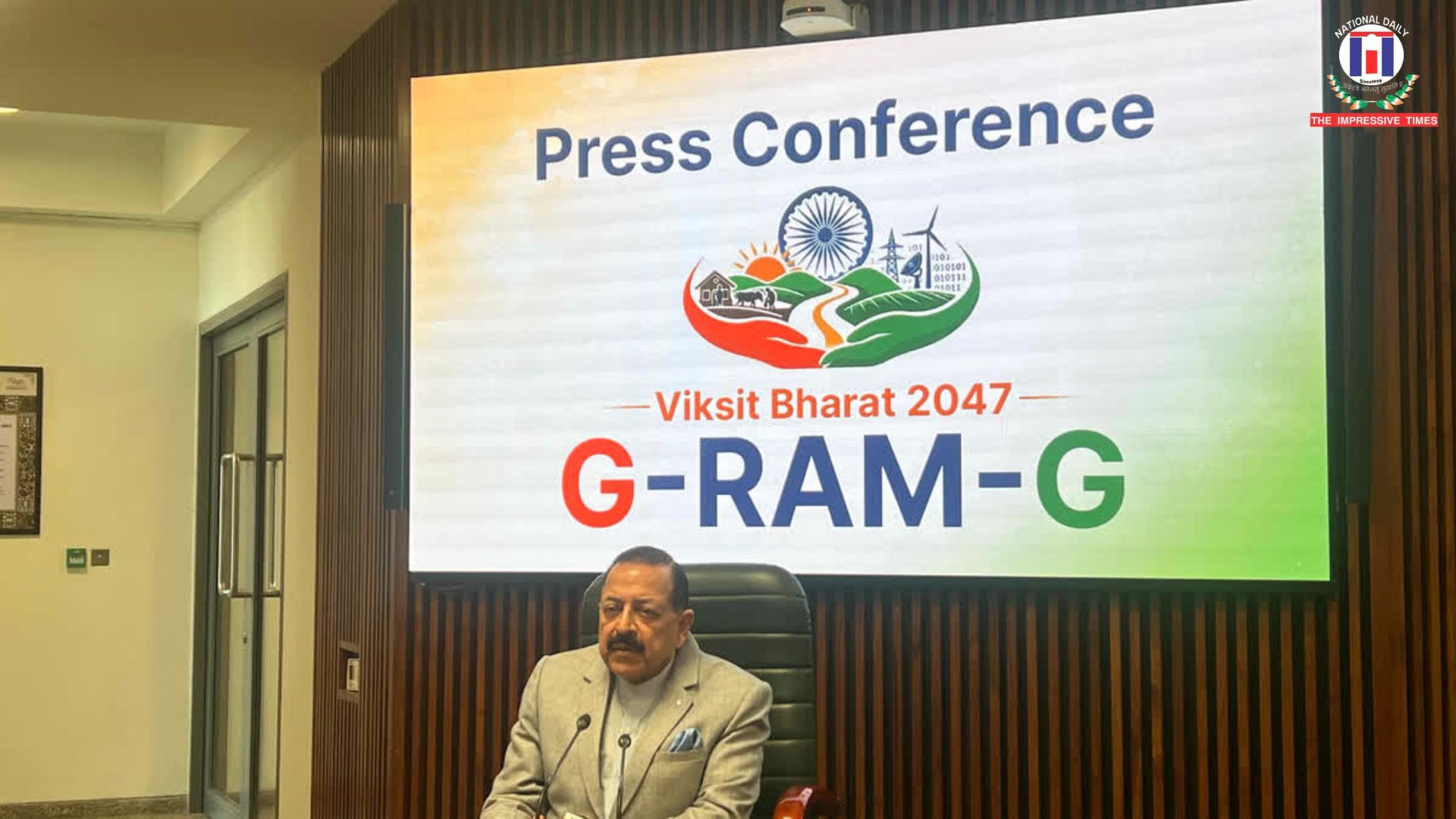
New Delhi: The Union government’s move to repeal the Mahatma Gandhi National Rural Employment Guarantee Act (MGNREGA), 2005, and replace it with the Viksit Bharat–Guarantee for Rozgar and Ajeevika Mission (Gramin) (VB-G RAM G) Bill, 2025, marks one of the most significant shifts in India’s rural welfare architecture in two decades. Tabled in Parliament last week, the proposed legislation aims to realign rural employment with the Centre’s “Viksit Bharat @ 2047” vision, emphasising technology-driven planning, infrastructure creation and fiscal discipline.
While explaining the rationale behind the overhaul, Minister of State of the Ministry of Personnel, Public Grievances and Pensions, Jitendra Singh, while addressing a press conference at Kartvya Bhawan in New Delhi on Tuesday, argued that the new framework seeks to address long-standing issues of leakages, inefficiencies and poor asset creation under MGNREGA.
“The more effort we put into going deeper into this, the better it will be,” Singh said, describing the Bill as part of a broader campaign to improve transparency, accountability and outcome-based governance through an integrated information system.
However, even as the government projects the VB-G RAM G Bill as a modernised alternative, critics warn that the proposed law fundamentally alters the rights-based, demand-driven nature of the rural employment guarantee, while shifting substantial financial and administrative responsibility onto state governments.
From MGNREGA To VB-G RAM G
MGNREGA was enacted in 2005. It guaranteed 100 days of wage employment to every rural household. The scheme was designed as a demand-driven programme, empowering gram panchayats to plan and execute work based on local needs. For example, during the Covid-19 pandemic, MGNREGA proved to be a critical safety net, generating approximately over 286 crore person-days of employment for the financial year 2024-25, providing assistance to nearly 5.8 crore households during such an unprecedented crisis.
The new Bill proposes to replace this framework with a statutory guarantee of 125 days employment per rural household every year. While this represents a nominal increase, the guarantee is no longer open-ended. Instead, the Centre will determine a “normative allocation” for each state, based on objective parameters, with any expenditure beyond this ceiling to be borne by the states.
According to the government, this shift introduces fiscal discipline. Jitendra Singh pointed at past instances of misuse, citing cases of ghost beneficiaries, repeated digging and filling of pits, and alleged collusion between local officials and political representatives.
“Where is the money coming from, and where is it going? These questions were not being answered earlier,” he said, adding that digital tracking would now ensure transparency and prevent such abuses.
Singh invoked Mahatma Gandhi’s ideals, contrasting them with past misuse, saying, “Mahatma Gandhi believed India lived in its villages, and stood for their genuine empowerment, not for practices like fake job cards or misuse of public funds.” He said Gandhian ideals were about accountability and integrity in governance, ensuring welfare money reaches intended beneficiaries. Singh added that preventing corruption in rural schemes is the key to uphold Gandhi’s legacy.
Changing The Funding Model
One of the most consequential changes lies in the Centre-state funding pattern. Under MGNREGA, the Union government bore 100 per cent of unskilled wage costs, and around 90 per cent of overall expenditure. The cost-sharing model under the new Bill requires all states to share 60 per cent of the cost with the Centre. The exception is for northeastern and Himalayan states, which will have to bear 10 per cent of the costs, and Union Territories without their own legislatures, which will receive all the funding from the Centre.
The additional burden on states will create new wage liabilities for state governments, as the VB-G RAM G Bill also shifts most of this liability to them. Although Singh said this will foster cooperation between states and lessen dependence on the Centre, several states have already raised concerns regarding fiscal stress, as they continue to operate under constrained budgets in the wake of GST.
“If states wish to provide more employment than what the normative allocation allows, they will have to pay from their own exchequer,” a senior rural development official noted. “That raises questions about whether the 125-day guarantee can meaningfully be realised on the ground.”
Under MGNREGA, states submitted annual labour budgets based on anticipated demand, and funds flowed accordingly. The VB-G RAM G Bill replaces this with a supply-driven model, where allocations are fixed in advance. Any additional demand for work beyond this allocation, does not automatically translate into additional Central funding.
Ministry officials anonymously admitted that critics have argued the new funding model undermines the very essence of an employment “guarantee”, that data from recent years show that even under MGNREGA, only about 7.6 per cent of households got employed for the full 100 days promised. That’s why, critics say the promise of 125 days could remaining rhetorical, unless backed by adequate and flexible funding.
Mandatory Pause During Agricultural Seasons
Another major departure is the statutory pause on public works during peak agricultural seasons. States will be required to notify up to 60 days each year, when no employment under the scheme can be undertaken, ostensibly to ensure adequate labour availability for farming.
The Union Minister defended this provision, saying it reflects practical realities and local agricultural calendars. “Labour cannot be in two places at once,” he said, noting that integrating employment planning with farming cycles would prevent shortages during sowing and harvesting.
However, labour economists point out that agriculture already employs nearly half of India’s workforce, while contributing less than a fifth of gross value added. They argue that policy should facilitate a shift away from agriculture towards non-farm employment, rather than pushing workers back into an overcrowded sector.
Centralised Planning, Panchayat Role In Question
The Bill makes it mandatory for the work proposals to originate from the Gram Panchayat Plans, which will be consolidated upwards and integrated into the National Rural Infrastructure Stack, aligned with the PM Gati Shakti’s Master Plan. State governments (at the Block level) will appoint Programme Officers to approve works and match the labour demand with the projects available.
This has raised concerns regarding the dilution of power of the Panchayati Raj system to plan its development at the local level. Under MGNREGA, gram sabhas and panchayats had a pivotal role in deciding which works were to be carried out. Critics say this new structure puts at risk the recentralisation of decision-making, thereby jeopardising the autonomy of gram sabhas and panchayats.
Technology As Backbone
A core foundation of the VB-G RAM G framework is technology dependent. The Bill incorporates technology by authorising Aadhaar-based authentication, GPS and mobile-enabled monitoring, using AI-powered fraud detection, which prove weekly public disclosure of works, along with enhancing the audits of the social audit processes.
Singh said these measures would eliminate corruption and ensure accountability. “This is about outcomes, targets and public interest,” he said.
But there are also significant challenges in applying this model at the grassroots. Many gram panchayats can’t guarantee the required level of digital compliance, because they do not have sufficient personnel with training and knowledge. As such, biometric verification and online systems could impede rural workers’ ability to enter the labour force, due to limited digital literacy.
The government has also argued that the original concept of MGNREGA, which was created 20 years ago, does not take into consideration contemporary rural conditions, resulting in the scheme suffering from insufficient monitoring, poor quality assets, and fraudulent practices. According to data, nearly Rs 194 crore was reported as “misappropriated” in 2024-25.
Whether the VB-G RAM G Bill successfully addresses these shortcomings without eroding the employment security of millions remains an open question. For millions of rural households, the outcome of this debate will shape not just how they work, but how they survive and aspire in a rapidly changing economy.

































No Comments: