Ashwini Vaishnaw Hails First Made-in-India Chips as a Historic Leap, Credits PM Modi’s Vision for Semiconductor Revolution
12 MoUs signed at SEMICON India 2025 to enhance domestic chip design, manufacturing, IoT, and microelectronics innovation.


 The Impressive Times
New Delhi- Prime Minister Narendra Modi today received the first set of Made-in-India semiconductor chips, marking a historic milestone in India’s growing technology ecosystem. Union Minister of Electronics and IT, Ashwini Vaishnaw, described the achievement as a “moment of pride,” highlighting the Prime Minister’s vision, decisive action, and leadership in fostering a self-reliant semiconductor industry.
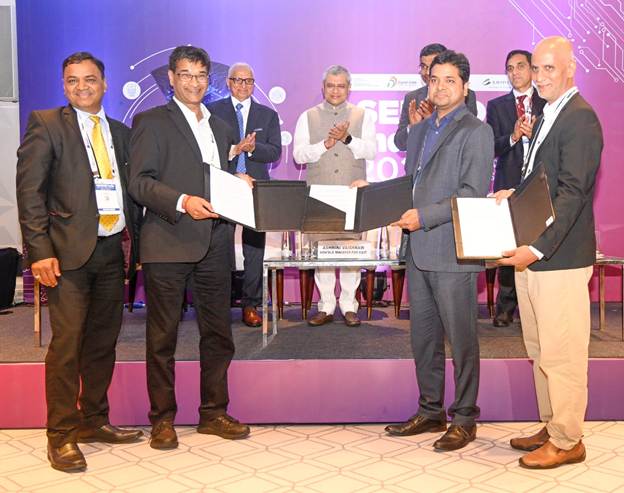
Since the launch of the India Semiconductor Mission (ISM) in December 2021, India has progressed from approvals to production in just three and a half years. At SEMICON India 2025, the event saw 12 MoUs signed to strengthen domestic capabilities in chip design, manufacturing of camera modules, MEMS microphones, miniature packaging, and the talent development ecosystem. A Deep Tech Alliance was also announced, backed by nearly $1 billion, to drive innovation across semiconductors, clean energy, quantum technology, and frontier sectors.
] Vaishnaw emphasized India’s global competitiveness, noting that semiconductor production in India is already 15–30% more cost-effective than international benchmarks. The ISM 2.0 initiative will further expand support across fabs, OSAT units, capital equipment, materials, and the complete semiconductor value chain.
A unique feature of the event was the presentation of 20 chips designed by Indian students at the Semi-Conductor Laboratory (SCL), highlighting the nation’s growing talent pool. Currently, 78 universities across India are using advanced EDA tools, and the country now accounts for nearly 20% of the global semiconductor workforce. Startups and institutions like IIT Madras have contributed to indigenous microcontrollers and processors, fostering innovation and design capabilities.
The MoUs signed at SEMICON India 2025 cover collaborations with leading global players, including ASML, Lam Research, Applied Materials, Merck, and Tokyo Electron, reflecting strong international confidence in India’s semiconductor mission. Projects include joint development of India’s first fully localized automotive camera modules, MEMS microphones, secure chips for digital identity, and IoT evolution boards with indigenous VEGA processors.
With an industry projection of $1 trillion by 2030, India is poised to become a global hub for semiconductors, delivering on PM Modi’s vision of making the country a trusted center for technological innovation while boosting economic growth and self-reliance.



































No Comments: