


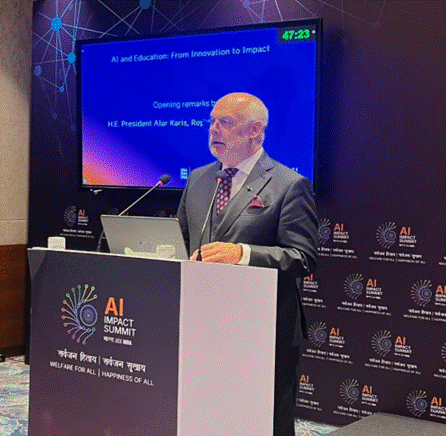
New Delhi, February 18, 2026: Emphasising that education will determine how responsibly Artificial Intelligence is used in society, Alar Karis, President of the Republic of Estonia, called for strengthening public education systems to ensure ethical and equitable deployment of AI in classrooms.
Speaking at a session titled “AI and Education: From Innovation to Impact” on the third day of the India AI Impact Summit 2026 at Bharat Mandapam, President Karis said the real question is not whether AI should be used in schools, but whether it is being applied thoughtfully and responsibly.
The session, organised in collaboration with the Embassy of Estonia in New Delhi, focused on scaling AI adoption across public education systems rather than limiting it to pilot projects.
AI Must Strengthen Public Education
President Karis noted that in Estonia, AI tools are already being used daily by students and teachers. However, he stressed that technology must enhance learning outcomes rather than replace human judgment.
He underscored that data and technology literacy form the backbone of modern democracies and revealed that Estonia has adopted a structured policy approach to expand AI knowledge among its citizens. The goal, he said, is to equip the majority of the population with basic AI skills, while enabling at least half to reach intermediate or advanced proficiency levels.
“Education is the key,” he observed, adding that AI integration must remain transparent and ethical to build public trust.
Teachers at the Core of AI Integration
Mary N. Kerema, Secretary for ICT, E-Government and Digital Economy, Republic of Kenya, highlighted the importance of teacher empowerment. She said infrastructure gaps such as limited connectivity or device shortages can be mitigated if teachers are adequately trained in AI usage.
“The most reliable infrastructure in education is the teacher,” she remarked, emphasising that ethical AI use begins in classrooms.
Dr. Pia Rebello Britto, Global Director of Education at UNICEF, cautioned that technological innovation must reduce, not widen, structural inequities. She pointed out that millions of children worldwide still struggle with basic literacy, warning that unchecked technological progress could leave vulnerable learners further behind.
Learning Outcomes Over Automation
Professor Petri Myllymäki of the Finnish Center for Artificial Intelligence addressed concerns around generative AI tools in classrooms. He stated that while AI can assist in tasks such as essay writing, the primary goal of education remains learning and critical thinking.
Ivo Visak, CEO of AI Leap Estonia, added that AI in education must be backed by strong pedagogical frameworks. He stressed that national trust and cross-sector collaboration are essential to successfully implement large-scale AI initiatives in schools.
2026 as the Year of Implementation
The session concluded with a call for coordinated national strategies, robust governance mechanisms and interoperable digital infrastructure to ensure AI benefits all learners. Participants agreed that responsible scaling, teacher-centric capacity building and public accountability will be critical in ensuring that AI strengthens education systems rather than disrupting them.
The discussion positioned 2026 as a decisive year for moving from experimentation to structured implementation, with education emerging as the cornerstone of ethical AI adoption worldwide.















































No Comments: