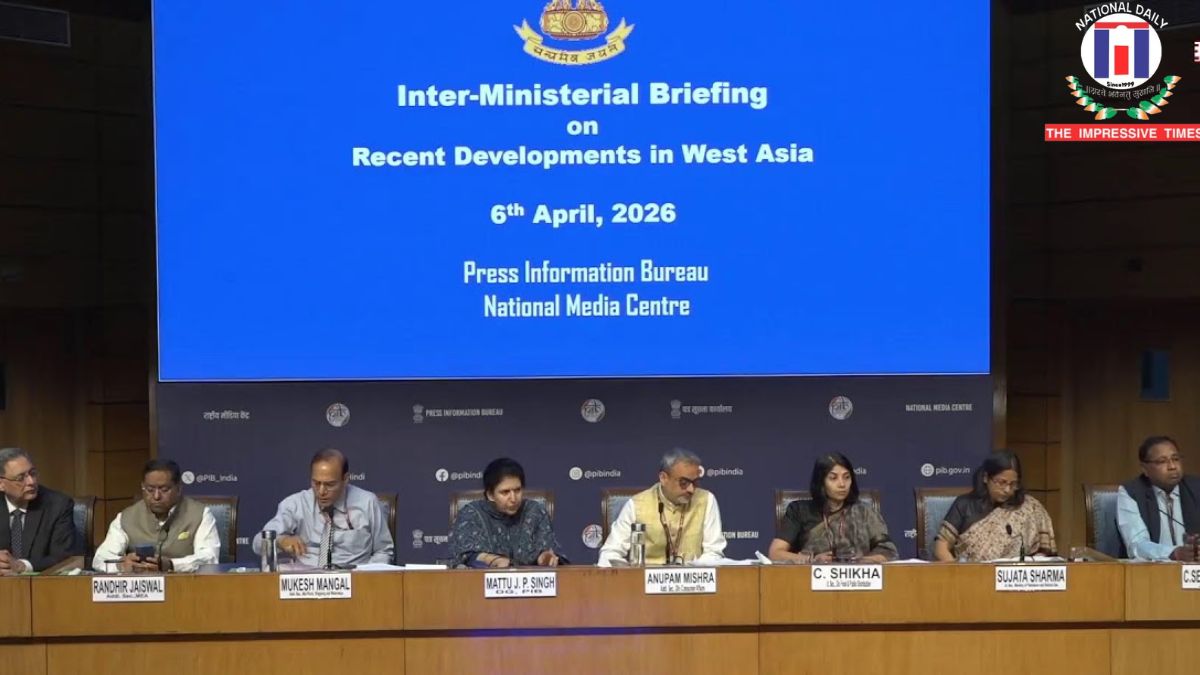
New Delhi : The inter-ministerial briefing on recent developments in West Asia reflects a government machinery operating in alert mode, attempting to manage the ripple effects of geopolitical instability on domestic stability. At the heart of this effort lies a delicate balancing act—ensuring that global disruptions do not translate into panic or shortages at home, while simultaneously safeguarding the interests of Indian citizens abroad.
West Asia has long been a region of strategic importance for India, not only as a major source of energy supplies but also as home to a large Indian diaspora. Any disruption in the region carries immediate implications for fuel availability, food prices, maritime trade, and the safety of millions of Indians. The government’s emphasis on preparedness, therefore, is both necessary and expected.
One of the most reassuring aspects of the briefing is the clarity on food security. With adequate buffer stocks of rice and wheat and a functioning Public Distribution System under the National Food Security framework, India appears well-positioned to absorb external shocks. The ability to intervene in markets through mechanisms like the Open Market Sale Scheme further strengthens this position, allowing the government to stabilise prices if volatility arises.
Equally significant is the update on essential commodities. The absence of unusual price fluctuations, despite global uncertainties, suggests that supply chains remain intact. This stability is not accidental; it is the result of continuous monitoring, coordination with states, and readiness to act against hoarding and black marketing. The establishment of a control room by the Department of Consumer Affairs underscores the importance of real-time information flow in managing such situations.
Energy security, however, presents a more complex challenge. The Strait of Hormuz, a critical chokepoint for global oil and gas supplies, remains a focal point of concern. In this context, the safe passage of Indian-flagged vessels like Green Sanvi and Green Asha is a positive development, but it also highlights the fragility of maritime routes on which India depends.
Domestically, the government’s strategy appears to be one of diversification and demand management. Encouraging the use of alternate fuels, expanding PNG connections, and rationalising LPG supply are measures aimed at reducing pressure on existing resources. The high rate of online LPG bookings and the continued delivery of cylinders indicate that distribution systems are functioning effectively, even under strain.
At the same time, the emphasis on avoiding panic buying is crucial. In times of uncertainty, perception can be as powerful as reality. Misinformation or rumours can trigger behaviour that disrupts supply chains, even when actual shortages do not exist. The call for states to conduct regular press briefings and counter fake news reflects an understanding that communication is a key component of crisis management.
The role of enforcement is another critical element. The large number of raids, seizures, and legal actions against hoarding and black marketing sends a strong signal that the system is actively guarding against exploitation. Such measures are essential to maintain public confidence and ensure equitable access to resources.
Beyond domestic concerns, the welfare of Indian nationals in the region remains a priority. The efforts of the Ministry of External Affairs in facilitating evacuations, maintaining helplines, and coordinating with local authorities demonstrate the scale and complexity of this task. The movement of thousands of individuals through alternative routes, often under challenging conditions, is a reminder of the human dimension of geopolitical crises.
The situation also highlights the importance of institutional coordination. Multiple ministries—ranging from petroleum and food to shipping and external affairs—must work in tandem to address interconnected challenges. The effectiveness of this coordination often determines how well a country can navigate external shocks.
However, while the current response appears robust, it also points to longer-term questions. How can India further reduce its vulnerability to external disruptions? What steps can be taken to diversify energy sources, strengthen domestic production, and build more resilient supply chains? These are questions that extend beyond immediate crisis management and into the realm of strategic planning.
The push towards expanding natural gas infrastructure and promoting alternative fuels is a step in this direction. Similarly, maintaining adequate food stocks and improving distribution systems contribute to resilience. Yet, the scale of global interdependence means that complete insulation is neither possible nor desirable. The goal, therefore, must be to manage dependence in a way that minimises risk.
Another important lesson is the role of adaptability. The ability to quickly adjust policies—whether it is altering LPG distribution norms, increasing refinery output, or facilitating new transit routes—demonstrates a responsive governance framework. In a rapidly changing environment, such flexibility is essential.
Ultimately, the current situation is a test of systems—of supply chains, institutions, and public trust. So far, the indicators suggest that these systems are holding steady. But sustaining this stability will require continued vigilance, transparent communication, and proactive planning.
In the end, crises of this nature are as much about preparedness as they are about response. India’s approach, as reflected in the briefing, shows an awareness of both. The challenge now is to maintain this balance, ensuring that external turbulence does not disrupt internal equilibrium, and that the country remains resilient in the face of uncertainty.







































No Comments: