Union Minister of State for Law & Justice, Arjun Ram Meghwal, Inaugurates State-of-the-Art 500 kW Rooftop Solar Power Plant & Launches E-Vidhan
“A defining step in clean governance—Delhi leads with solar power and e-Vidhan,” stated CM Rekha Gupta.


 The Impressive Times
New Delhi – The Delhi Legislative Assembly today marked a historic milestone in environmental sustainability and digital governance by becoming the first legislature in the country to run entirely on solar energy. A state-of-the-art 500-kilowatt rooftop solar power plant, along with the National e-Vidhan Application (NeVA), was formally inaugurated by Union Minister of State for Law & Justice, Arjun Ram Meghwal, in the august presence of Speaker Vijender Gupta. Chief Minister of Delhi, Rekha Gupta, graced the occasion as the Chief Guest. The event was also attended by Deputy Speaker Mohan Singh Bisht, Minister of Public Works Department Parvesh Sahib Singh, Minister of Power Ashish Sood, and Chief Whip Abhay Verma.
The Assembly’s solar initiative is projected to yield savings of up to ₹15 lakh per month—approximately ₹1.75 crore annually—and is expected to swiftly recover its cost, while also potentially generating surplus electricity through net metering. The integration of the E-Vidhan platform further advances the Assembly’s digital transformation by enabling a paperless legislative process, thereby promoting administrative efficiency and significantly reducing the institution’s carbon footprint.
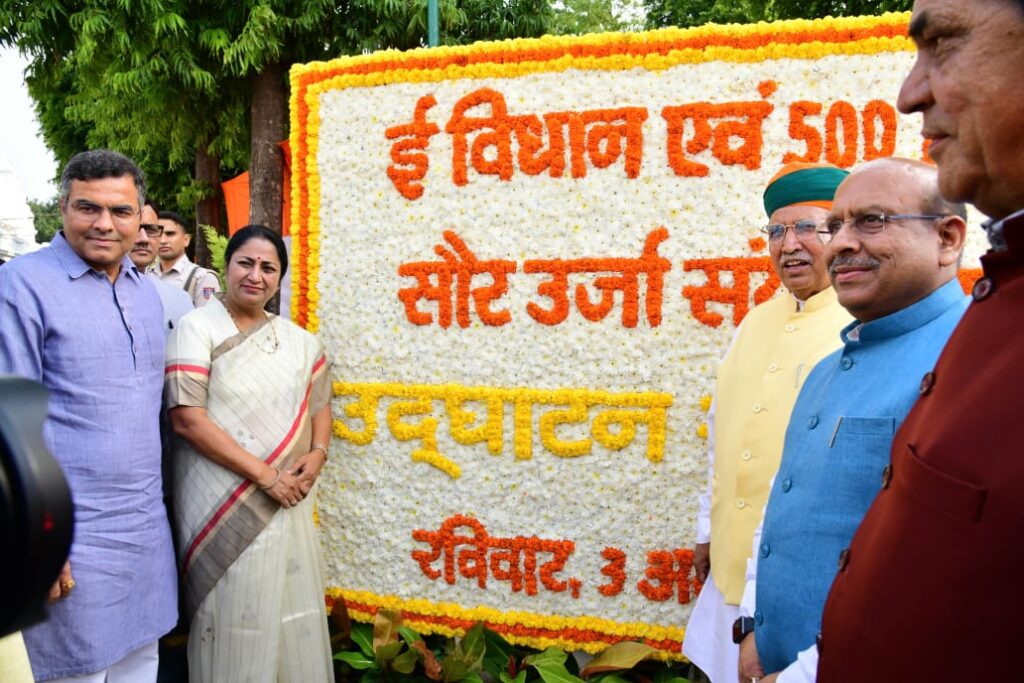
Speaking at the inauguration, Union Minister Arjun Ram Meghwal hailed the initiative as a model for sustainable governance across India. He stated that the Delhi Assembly’s complete transition to solar energy sets a benchmark for legislative and public institutions nationwide. Meghwal credited this remarkable progress to the visionary leadership of Prime MinisterNarendra Modi and praised Delhi’s legislature for embodying this transformation, where sustainability, self-reliance, and digital empowerment go hand in hand.
Meghwal further remarked that the launch of NeVA at the Delhi Assembly under the ‘One Nation, One Application’ initiative of Digital India 2.0 signifies not just an infrastructure upgrade, but a shift in institutional values.
With full implementation expected in the upcoming Monsoon Session, the Delhi Assembly will transition to completely paperless operations. He affirmed that this fusion of climate responsibility and administrative reform must begin at the heart of democratic institutions. He also assured that the Ministry of Parliamentary Affairs will provide all possible assistance to the efforts and initiatives of the Delhi Legislative Assembly in this regard.
Speaker Vijender Gupta, while addressing the gathering, emphasized that the solarization of the Assembly is a cornerstone in a broader institutional shift towards sustainable and digital transformation.
Gupta added, “The successful commissioning of the solar plant marks a new chapter in our commitment to cleaner energy and public responsibility. We are proud to lead by example and demonstrate how legislative institutions can champion environmental stewardship.” He informed that the present Assembly building was constructed in 1912 and was home to the country’s first Parliament—Desh ki pehli Sansad yahan thi. Highlighting the balance between tradition and progress, he remarked, “Virasat aur Vikaas saath chalega.”
Speaker further informed that the work of E-Vidhan was completed in just 100 days through the dedicated efforts of the National e-Vidhan Application team. A trial run of the new system is scheduled for 11:00 AM tomorrow, followed by a House sitting at 2:00 PM, which will be held entirely on solar power without using electricity from conventional sources.
Gupta reiterated that the financial savings generated through solar energy would be reinvested in developmental work for the welfare of Delhi’s people. He also outlined complementary digital initiatives, including the digitisation of the Assembly Library and ongoing enhancements to IT infrastructure aimed at improving access to legislative resources and strengthening administrative efficiency. By embracing both clean energy and digital workflows, the Delhi Legislative Assembly is contributing directly to India’s net-zero targets and setting a national example of climate-conscious governance.
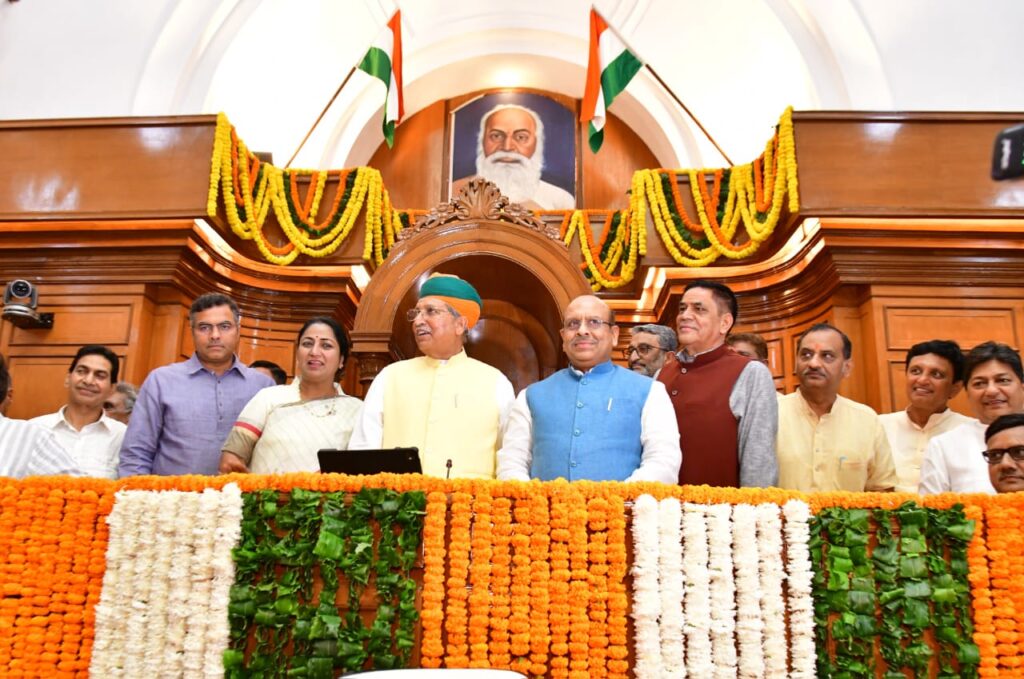
CM Rekha Gupta described the commissioning of the 500 kW solar power plant as a turning point in institutional accountability toward environmental protection. She emphasised that Delhi’s capital legislature must lead the way in India’s transition to sustainable and efficient governance, especially at a time when the nation has already surpassed 50% non-fossil fuel capacity under the leadership of Prime Minister Narendra Modi. She highlighted that with the rollout of NeVA in the Monsoon Session, the Delhi Assembly is poised to offer a more transparent, accessible, and digitally empowered legislative experience.
CM Gupta stressed that these developments are not isolated acts, but reflect an evolving vision of 21st-century governance—one where innovation, ecology, and institutional responsibility are central, not peripheral.
Minister of Public Works Department, Parvesh Sahib Singh, commended the initiative as a progressive step toward climate-resilient public infrastructure and expressed hope that it would serve as a catalyst for similar efforts in other institutions. He praised the swift completion of the complex project, highlighting that under the leadership of Speaker Vijender Gupta, it was executed within budget—enabling savings to be redirected for public welfare.
Minister of Power, Ashish Sood, praised the Assembly’s solar transition as a commendable move aligned with Delhi’s broader vision of promoting rooftop solar adoption and enhancing grid efficiency.
Deputy Speaker Mohan Singh Bisht noted that the successful commissioning of the solar plant is a proud and defining moment for the institution, reiterating that democratic bodies must lead by example in adopting sustainable practices.
Ahead of the formal inauguration, all Members of the Delhi Legislative Assembly participated in a successful trial run of the NeVA platform. The trial offered firsthand experience of the digital interface, which includes smart delegate units with microphones and voting panels, RFID/NFC access, multilingual support, real-time document access via iPads, an automated AV system with HD cameras, and a secure, power-backed networking environment. This seamless transition represents a confident step toward paperless, efficient, and technologically advanced legislative functioning.

The Delhi Legislative Assembly’s shift to solar energy and digital governance reflects a strong institutional commitment to environmental stewardship and democratic innovation. Aligned with India’s net-zero ambitions and national programmes like the Green Energy Corridor and the International Solar Alliance, the Assembly’s initiatives affirm that true leadership on climate action and digital transformation must begin within the very core of governance.



































No Comments: