National Symposium Calls for Systemic Change to Ensure Women’s Safety in Workplaces and Public Spaces
NHRC and University of Lucknow collaborate to host crucial dialogue on gender rights amid rising violence against women


 The Impressive Times
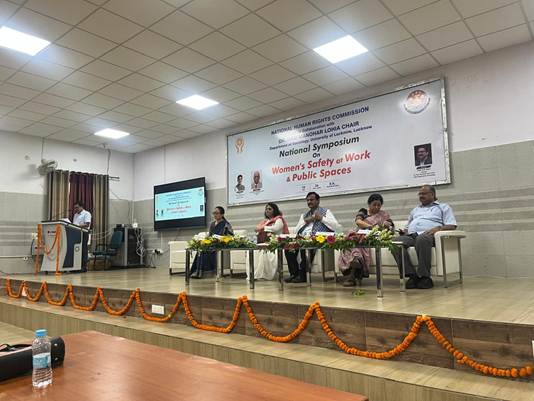
Lucknow — The National Human Rights Commission (NHRC) of India, in partnership with the Dr. Ram Manohar Lohia Chair at the Department of Sociology, University of Lucknow, held a National Symposium on Women’s Safety at Work and Public Spaces on July 26. The event, now in its second edition, brought together legal experts, academics, and policymakers to address the persistent and evolving threats to women’s safety across India.
The symposium follows a troubling rise in cases of violence and harassment targeting women, both in professional environments and public life. Against this backdrop, participants underscored the urgent need for structural reform, cultural change, and active community engagement.
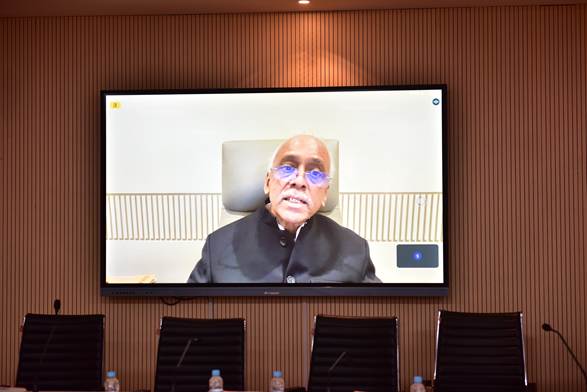
Delivering the keynote address virtually, NHRC Chairperson Justice V. Ramasubramanian pointed to the stark contradiction between India’s spiritual reverence for female deities and the harsh realities faced by women on the ground. He cited official statistics revealing that an average of 51 cases of gender-based crimes are filed every hour, and stressed that mere legislation is insufficient unless matched by effective implementation and public accountability.
He also revisited the difficult journey toward the passage of the Prevention of Sexual Harassment at Workplace Act, 2013, highlighting how much further India still needs to go to ensure genuine safety and dignity for women.
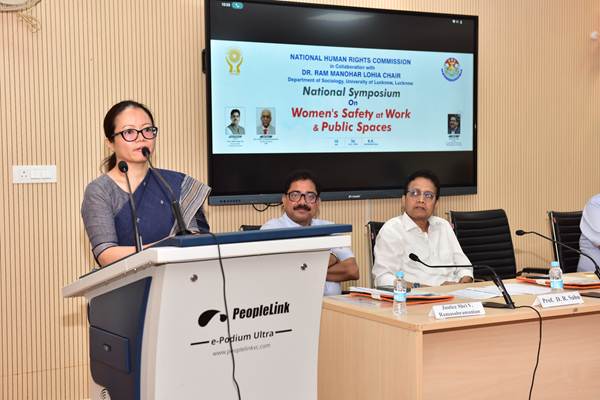
Saidingpuii Chhakchhuak, Joint Secretary at NHRC, shared personal experiences to shed light on the ongoing struggle women face despite legal protections. She called for proactive enforcement, societal awareness, and a shift in attitudes that go beyond surface-level sensitivity.
“Our society still normalises many forms of non-physical, psychological, or institutional violence against women,” she said, urging educators to actively champion gender equity in their spheres of influence.
Several noted scholars brought in varied perspectives to the discussion. Prof. S.K. Chowdhury of the University of Lucknow stressed that the constitutional promises of liberty and equality must be translated into real-life confidence among women to report crimes. He called for rebuilding trust in institutions and law enforcement.
Adding a broader lens, Prof. S.M. Patnaik of the University of Delhi examined the cultural underpinnings of public harassment. “Patriarchal structures and the anonymity of urban life are breeding grounds for gendered violence,” he warned. He emphasised the importance of empathy, early gender sensitisation, and accessible support systems.
Dr. P.K. Gupta, another academic from the University of Lucknow, focused on the deep-seated behavioural norms within families that fuel domestic abuse. “If we want society to evolve, change has to begin within homes,” he said.
Dr. S.N. Sabat, Chairperson of the Uttar Pradesh Subordinate Services Selection Commission, advocated for deploying new technologies and surveillance tools to improve women’s safety, particularly in cities. Meanwhile, Prof. Nilika Mehrotra from JNU turned attention to public transport, stressing the need for context-driven solutions rather than blanket policies.
“Safety must be integrated into urban planning, public infrastructure, and judicial sensitivity. There’s no single solution that fits all social realities,” she asserted.
The symposium concluded with a collective call to action across several key fronts:
Comprehensive Strategy: Policies, implementation mechanisms, and public outreach must work in tandem to address women’s safety holistically.
Inclusivity in Focus: Greater attention must be paid to the informal sector, where women remain especially vulnerable due to lack of institutional support.
Family-Level Awareness: Shifting deep-rooted mindsets requires starting at home—raising boys and girls alike to value safety, consent, and equality.
Women in Power: Representation of women in legislative, administrative, and leadership roles is essential to enable lasting structural transformation.
Educational Responsibility: Schools and universities should cultivate gender sensitivity and equip students with the tools to responsibly navigate gender dynamics.
As the session drew to a close, NHRC reaffirmed its dedication to advancing gender equity and strengthening collaboration between institutions to build a future where women feel safe and empowered in every sphere—be it a classroom, boardroom, or public space.
The event also highlighted existing initiatives such as SHE-Box, One Stop Centres, and Pink Police Booths—while stressing the need to expand and adapt them to evolving challenges.







































No Comments: