Jal Shakti Ministry Holds High-Level Meet to Reinforce Water Governance and Service Delivery
Union Minister C. R. Patil chairs a national-level brainstorming session to enhance water security, strengthen institutions, and ensure sustainable water management across India.
New Delhi: The Ministry of Jal Shakti convened a high-level brainstorming session on Wednesday under the chairmanship of Union Minister C. R. Patil to discuss comprehensive strategies for strengthening water governance, improving service delivery and ensuring long-term water security across the country. The session was attended by the Ministers of State for Jal Shakti, V. Somanna and Dr Raj Bhushan Choudhary, along with senior officers of the Ministry.
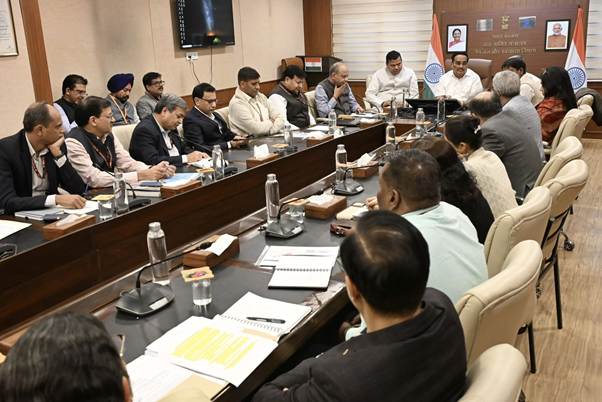
The meeting featured an open, constructive exchange of ideas focusing on water resources management, drinking water and sanitation systems, river rejuvenation, irrigation efficiency, institutional reforms, and the adoption of modern technology. Discussions centred on addressing existing challenges as well as preparing for emerging issues linked to climate change.
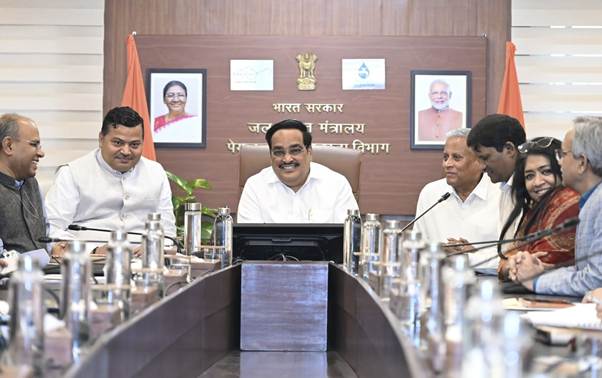
In his address, C. R. Patil emphasised that water is fundamental to every stage of human life and highlighted the need for continuous improvement in the quality of service delivery. He stressed efficient financial planning, responsible utilisation of public funds and greater community participation as key pillars of sustainable water governance. Patil also underlined the importance of water awareness at the school level and scaling up successful models being implemented across states.
He reaffirmed that under the leadership of Prime Minister Narendra Modi, the Government remains committed to delivering water and sanitation services through transparent, responsive and citizen-centric governance systems.
Ministers of State V. Somanna and Dr Raj Bhushan Choudhary recommended adopting an integrated approach to water management, tackling floods and droughts holistically, improving data utilisation, promoting rainwater harvesting, and boosting efficient use of both surface water and groundwater. They also emphasised the importance of climate resilience and preparedness to address future water-related challenges.
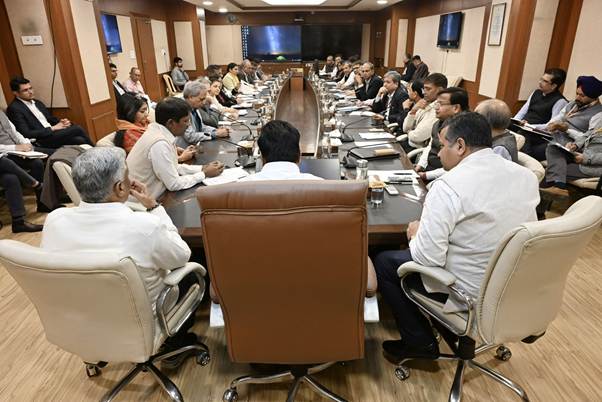
Senior officials from the Ministry highlighted the need to strengthen service delivery frameworks, deepen convergence among schemes, enhance institutional mechanisms, and bolster capacity building at the grassroots. They reiterated that effective and sustainable implementation of water-related flagship programmes must remain a top priority.
The Ministry noted that structured interactions of this nature help align national priorities, identify operational bottlenecks, and promote coordinated efforts among key stakeholders. The key suggestions and insights from the session will now be compiled for follow-up action in consultation with states and concerned departments.










































No Comments: