An Indian Will Announce ‘Viksit Bharat 2047’ from Moon in 2040, Says Dr. Jitendra Singh at National Space Day
India charts 15-year space roadmap with 100+ satellites, greater private sector role


 The Impressive Times
New Delhi — Union Minister for Science & Technology Dr. Jitendra Singh on Saturday said that an Indian astronaut will announce “Viksit Bharat 2047” from the surface of the Moon in 2040, sending a powerful message across the universe that India has truly arrived.
Speaking at the National Space Day celebrations at Bharat Mandapam, the Minister described India’s space journey as one that goes far beyond rockets and satellites. “It is about empowering people, improving lives, and shaping a better future,” he said, while recalling Prime Minister Narendra Modi’s 2014 vision of integrating space technology into governance.
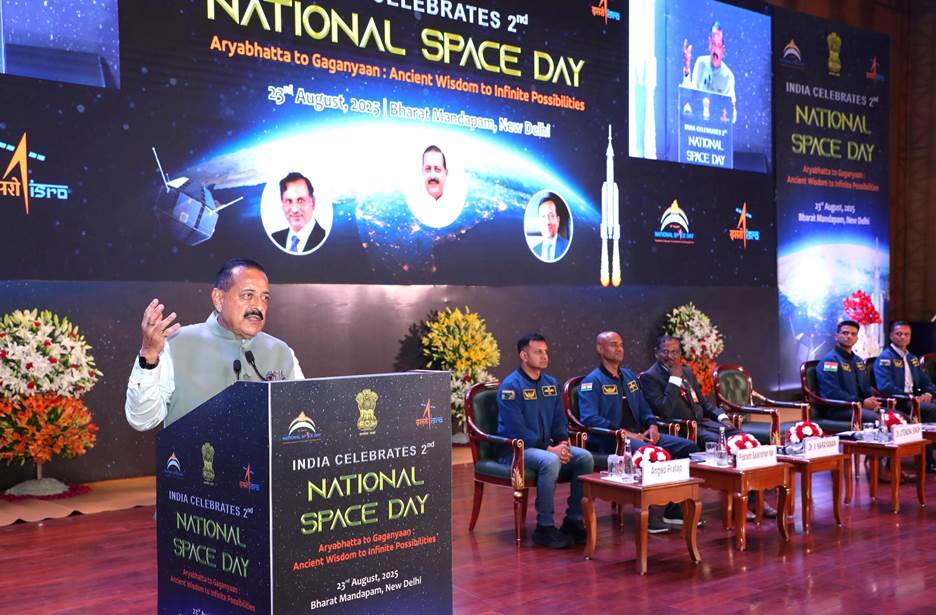
Dr. Singh unveiled a 15-year roadmap for India’s space programme, charting the launch of more than 100 satellites by 2040. Around 70 percent of these will be small satellites, with missions to be carried out jointly by government technology projects and private sector-led operations. He underlined that the roadmap will leverage space technology to ensure food and water security, disaster resilience, environmental sustainability, and inclusive growth.
The Minister emphasized that India’s space programme has entered a transformative phase, evolving from symbolic achievements to becoming a major driver of science, innovation, and public welfare. He highlighted the increasing role of private players and start-ups in space exploration, noting that technologies developed by them are finding use in interplanetary missions as well as everyday governance.
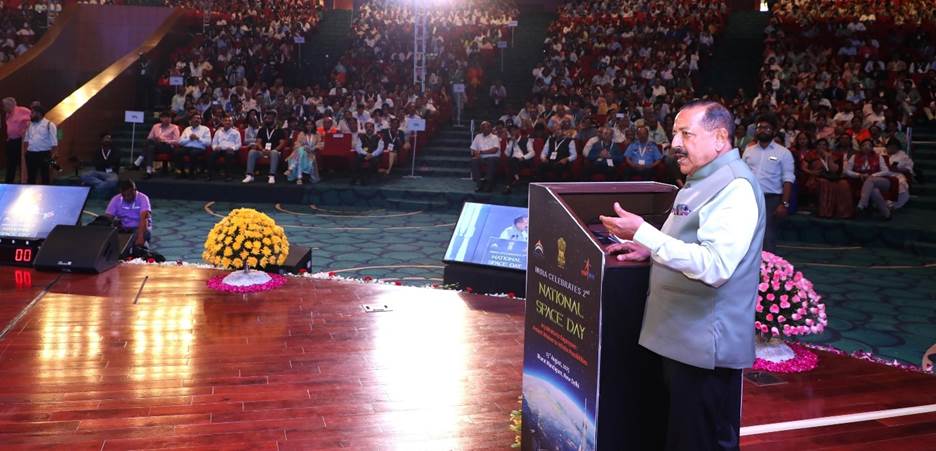
The event also honoured winners of the Bharatiya Antariksh Hackathon-2025 and the ISRO Robotics Challenge (IRoC-U 2025). The hackathon drew participation from over 61,000 students, with problem statements ranging from geospatial technologies to AI/ML applications, while the robotics challenge tasked students with creating autonomous aerial systems capable of functioning in Mars-like conditions.
Looking ahead, Dr. Singh outlined ISRO’s ambitious plans:
This year’s National Space Day was themed “Aryabhatta to Gaganyaan: Ancient Wisdom to Infinite Possibilities”, symbolizing India’s unique strength of combining traditional knowledge with modern innovation.
The event was attended by the four astronauts preparing for the Gaganyaan mission — Group Captains Prasanth Balakrishnan Nair, Ajit Krishnan, Angad Pratap, and Wing Commander Shubhanshu Shukla — along with ISRO Chairman Dr. V. Narayanan, who briefed the gathering on the Human Spaceflight Programme and upcoming projects.
“India is no longer a follower; today, the world looks to India to add value to global space missions,” Dr. Singh said, stressing that National Space Day is both a celebration of past achievements and a call to explore new horizons.






























No Comments: